 Fibrosis Unlocking: Beyond “Contracture Management”
Week 18, 2026. This week Study #1 (PMID: 42021719) is a massive Additive breakthrough for the CLEAR domain, redefining contractures from “short muscles” to Active Cellular Scars. See more below…
Every week, BRIGHT reviews the latest cerebral palsy and brain injury research from NCBI PubMed and Entrez databases. We categorize each study into the ten NeuroLoop Protocol Domains and evaluate its impact: Additive, Supportive, or Legacy. New “Additive” research is instantly integrated, ensuring the NeuroLoop Protocol remains the global gold standard for neuro-rehabilitation. Supportive studies validate existing methods, and Legacy studies evaluate the current standard care with little to no impact on neuro-repair.
BRIGHT NeuroLoop Protocol Analysis: Week 18, 2026
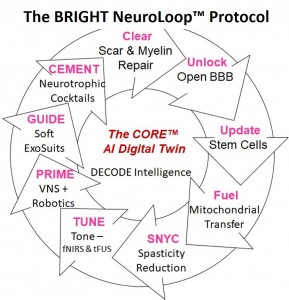
The research landscape for Week 18 reveals a robust commitment to the DECODE step (mapping), with studies like 18-26:2 and 18-26:19 providing granular data on cortical activation and diaphragmatic kinematics. These supportive works refine our CORE (Digitial Twin), while the SYNC step (therapy) remains active through studies like 18-26:4 and 18-26:12, which validate the integration of exergaming and constraint therapy into the neural loop.
However, the protocol faces significant “gaping holes” in two critical areas. In the UPDATE (non-invasive interfaces) domain, we lack any fresh data on high-bandwidth, brain-to-muscle interfaces that could bypass damaged pathways. Similarly, the FUEL (metabolic/cellular) domain is lagging; while 18-26:22 touches on neonatal neuroprotection, there is a total absence of research on cellular fueling or mitochondrial optimization for the adult or adolescent CP majority.
BRIGHT NeuroLoop Protocol Additive Research: Week 18, 2026
Fibrosis Unlocking: Beyond “Contracture Management
Study #1 (PMID: 42021719) is a massive Additive breakthrough for the CLEAR domain, redefining contractures from “short muscles” to Active Cellular Scars. Historically, CP research focused on “tightness” as a secondary mechanical byproduct of spasticity. This single-cell analysis proves that the muscle environment is actually being reprogrammed into a pro-fibrotic state, where “anti-myogenic” stem cells actively block repair and build internal “bolts” of scar tissue. This is the first time we’ve seen the molecular “lock” in such high resolution.
By identifying specific cellular populations—likely treatable with low-risk anti-fibrotic agents like Losartan (which modulates TGF-beta signaling)—we can truly “clear” the barrier that prevents neuroplasticity from translating into movement. This helps the majority of the CP population, specifically those with Spastic Diplegia or Hemiplegia, where structural “stiffness” often remains even after Botox or SDR. We are no longer just stretching the muscle; we are Unlocking the Fibrosis to allow the NeuroLoop’s signals to finally reach a responsive, healthy tissue
New Insight: Immune/metabolic priming via the gut-brain axis.
Study #7 (PMID: 42026999) is additive to PRIME by demonstrating how ketogenic diet modulates gut microbiota, priming the brain for enhanced plasticity across CP subtypes.
Week 18 Citations Sorted by BRIGHT NeuroLoop Protocol Domain and their status within the Protocol (Additive, Supportive, or Legacy).
| Index | Domain | Short Title / Focus | Status | BRIGHT Context |
| 18-26:1 | DECODE | Muscle Cell Single-Cell Analysis | Additive | New Data: Molecular-level precision for decoding muscle fibrosis. |
| 18-26:15 | DECODE | Genetic Findings in Korean Children | Supportive | New Data: Genomic decoding of CP etiologies in specific populations. |
| 18-26:2 | DECODE | fNIRS Cortical Activation Mapping | Supportive | Mapping: Correlating brain activity with gait performance. |
| 18-26:13 | DECODE | Bioelectrical Impedance Analysis | Supportive | Mapping: Validating body composition metrics for Digital Twins. |
| 18-26:19 | DECODE | Diaphragmatic Ultrasound Kinematics | Supportive | Mapping: Morphometry data for respiratory subsystem modeling. |
| 18-26:24 | DECODE | Preterm Neurodevelopmental Factors | Supportive | Baseline: Identifying risk factors for neurodevelopmental Twins. |
| 18-26:25 | DECODE | Fetal Reduction & Disorders Study | Supportive | Baseline: Population-level decoding of early neuro-risks. |
| 18-26:6 | CLEAR | Botulinum Toxin Adverse Events | Legacy | Safety: Identifying risks in standard barrier-clearing protocols. |
| 18-26:22 | FUEL | Erythropoiesis-Stimulating Agents | Supportive | Fueling: Meta-analysis of metabolic neuroprotection in preterms. |
| 18-26:4 | SYNC | CIMT Review & Neuroplasticity | Supportive | Syncing: Evidence for constraint-induced neural loop integration. |
| 18-26:5 | SYNC | Aquatic Therapy Case Study | Supportive | Syncing: Supportive motor training in buoyancy-reduced environments. |
| 18-26:12 | SYNC | NMES & Exergaming for Toe-Walking | Supportive | Syncing: Combining electrical stimulation with active engagement. |
| 18-26:14 | TUNE | VR Biofeedback Treadmill Training | Supportive | New Tool: Real-time tuning of gait through virtual biofeedback. |
| 18-26:3 | TUNE | Optimized AFO Functional Outcomes | Supportive | Tuning: Refining orthotic alignment for functional optimization. |
| 18-26:7 | PRIME | Gut Microbiota & Ketogenic Diet | Additive | New Insight: Immune/metabolic priming via the gut-brain axis. |
| 18-26:23 | PRIME | CMV Prevention & Screening | Supportive | Priming: Managing infectious barriers to neurodevelopment. |
| 18-26:8 | GUIDE | Long-Term Respiratory Support | Legacy | Management: Standard protocols for chronic respiratory care. |
| 18-26:9 | GUIDE | Oral Health Clinical Records | Legacy | Management: Baseline health maintenance for special needs. |
| 18-26:10 | GUIDE | Pediatric Pain & Vulnerability | Legacy | Management: Descriptive analysis of pain in pediatric populations. |
| 18-26:11 | GUIDE | ChatGPT-4 Reliability for CP | Legacy | Management: Evaluation of digital health information tools. |
| 18-26:16 | GUIDE | Pregnancy Outcomes in CP | Legacy | Management: Observational data on maternal health in CP. |
| 18-26:17 | GUIDE | Family Caregiver Strain in Ghana | Legacy | Management: Psychosocial baseline for global caregiver support. |
| 18-26:18 | GUIDE | CP Surveillance in Brazil | Legacy | Management: Landmark population-based surveillance progress. |
| 18-26:21 | GUIDE | Disability Bias in Orthopaedics | Legacy | Management: Descriptive study of systemic clinical barriers. |
| 18-26:20 | CEMENT | Reconstructive Hip Surgery Trends | Legacy | Structural: Tracking standard orthopedic intervention patterns. |
Full Citation List
| Index | Citation |
| 18-26:1 | 1.Single cell analysis of muscle contracture in cerebral palsy reveals pro-fibrotic and anti-myogenic stem cell populations with altered cell-cell interactions Madison Stewart, Lin-Ya Hu, Taryn Loomis, Sarah E Brashear, Lizbeth M De La Torre, Anas Mohamed Sulthan, Marie Villalba, Jon R Davids, Yue Wang, Vedant A Kulkarni, Lucas R Smith Am J Physiol Cell Physiol – 2026 Apr 23 (Online ahead of print) PMID: 42021719 |
| 18-26-2 | 2.The gait performance, sensorimotor cortical activation and their correlation during walking task among children with cerebral palsy: a fNIRS study Zhilin Jiang, Guocai Xu, Liuxin Qi, Wei Sun, Zhenxiang Tian, Jiangna Wang BMC Pediatr – 2026 Apr 24 (Online ahead of print) PMID: 42026514 |
| 18-26-3 | 3.Impact of optimized AFOs on functional outcomes in children with spastic cerebral palsy Teresa Long Pierce, Alyssa LaForme Fiss, Mark Geil, Karl Barner J Pediatr Rehabil Med – 2026 Apr 24 (Online ahead of print) PMID: 42029660 |
| 18-26-4 | 4.Constraint-Induced Movement Therapy in Children With Hemiplegic Cerebral Palsy: A Scoping Review of Functional Outcomes and Neuroplasticity-Related Evidence Maria Grazia Maggio, Maria Chiara Valeri, Raffaela Maione, Angela Militi, Alex Martino Cinnera, Irene Ciancarelli, Rocco Salvatore Calabrò, Giovanni Morone Ann Rehabil Med – 2026 Apr 22 (Online ahead of print) PMID: 42015389 |
| 18-26-5 | 5.Aquatic Therapy for a 13-Year-Old With Severe Central Hypotonia and Motor Impairment Following Post-Transplant Encephalopathy: A Hypothesis-Generating Single-Case Study Tamotsu Yabumoto, Yuumi Ajioka, Hirofumi Fujii Physiother Res Int – 2026 Apr;31(2):e70221 PMID: 41999345 |
| 18-26-6 | 6.Adverse neurological events following botulinum toxin type A: A case series of post-injection seizures and paralysis Qiaozhen Li, Chunqiu Dai, Hongbin Wang, Feng Feng, Xiao Xi, Hong Wang, Hua Yuan, Xiaolong Sun Case Reports Toxicon X – 2026 Apr 7;30:100255 PMID: 42027624 |
| 18-26-7 | 7.Ketogenic diet modulates gut microbiota composition in an experimental model of cerebral palsy Jakssuel Sebastion Dantas Alves, Nathalia Caroline De Oliveira Melo, Ana Elisa Toscano, Raul Manhães-De-Castro, Clevson Xavier Fraga Filho, José Patrocínio Ribeiro Cruz Neto, José Luiz De Brito Alves, Gisélia De Santana Muniz Nutr Neurosci – 2026 Apr 24 (Online ahead of print) PMID: 42026999 |
| 18-26-8 | 8.Outcomes of children and young people with cerebral palsy receiving long-term respiratory support: A systematic review Rajkumar Dhandayuthapani, Alasdair Campbell, Catherine M McDougall, Florian Gahleitner, Steve Cunningham, Don S Urquhart Dev Med Child Neurol – 2026 Apr 23 (Online ahead of print) PMID: 42026895 |
| 18-26-9 | 9.Evaluation of oral health conditions among children with special health care needs using clinical records Anran Wang Front Public Health – 2026 Apr 7;14:1738526 PMID: 42022834 |
| 18-26-10 | 10.Vulnerability and Pediatric Pain S van Rysewyk, D Harrison, A Harvey, E Ilhan Paediatr Neonatal Pain – 2026 Apr 20;8(2):e70020 PMID: 42017122 |
| 18-26-11 | 11.Evaluation of the quality, reliability, and readability of ChatGPT-4 responses related to the treatment and rehabilitation of children with cerebral palsy Rabia Zorlular, Ali Zorlular Eur J Pediatr – 2026 Apr 24;185(5) PMID: 42032341 |
| 18-26-12 | 12.Functional neuromuscular electrical stimulation while exergaming for toe-walking: a retrospective case report Elise Baron, Nora Bachman Physiother Theory Pract – 2026 Apr 24 (Online ahead of print) PMID: 42028891 |
| 18-26-13 | 13.Validity of bioelectrical impedance analysis to estimate body composition in patients with severe motor and intellectual disabilities Taiyu Kurima, Yukiyo Shimizu, Yasushi Hada, Tomohiro Nakayama Brain Dev – 2026 Apr 21;48(3):104536 PMID: 42019160 |
| 18-26-14 | 14.Clinical Integration of a Goal-Specific Virtual-Reality Biofeedback Treadmill Training Program for Children with Cerebral Palsy Gilad Sorek, Itai Schurr, Simon-Henri Schless Phys Occup Ther Pediatr – 2026 Apr 22 (Online ahead of print) PMID: 42017438 |
| 18-26-15 | 15.Genetic testing and genetic findings in Korean children with cerebral palsy You Gyoung Yi, Jeong-Yi Kwon, Jayoung Choi, Dong-Wook Rha, Juntaek Hong, Yong Beom Shin, Shin-Seung Yang, Sangwon Hwang, Sunyoung Joo, Dae-Hyun Jang Dev Med Child Neurol – 2026 Apr 25 (Online ahead of print) PMID: 42033120 |
| 18-26-16 | 16.Pregnancy outcomes among individuals with cerebral palsy: A population-based cohort study Marina Vainder, Anne Berndl, Aditi Patrikar, Hilary K Brown BJOG – 2026 Apr 22 (Online ahead of print) PMID: 42020348 |
| 18-26-17 | 17.”Between Strain and Perceptions,” The Voices of Family Caregivers Involved in the Care of Children with Cerebral Palsy: Evidence from a Ghanaian Low Socioeconomic Setting Shafawu Adamu, Vivian Efua Senoo-Dogbey, Prosper Junior Anatsui, Monica Charlotte Akpagloh, Delali Adwoa Wuaku, Esther Anaba, Wilson Atara Asakia Sage Open Pediatr – 2026 Apr 16;13:30502225261441988 PMID: 42011211 |
| 18-26-18 | 18.Cerebral palsy in Brazil: A landmark step toward population-based surveillance in Latin America Eduardo Cuestas Dev Med Child Neurol – 2026 Apr 20 (Online ahead of print) PMID: 42008795 |
| 18-26-19 | 19.Ultrasound-derived diaphragmatic kinematic and morphometry parameters in children with cerebral palsy: a comparative cross-sectional study Paulo A F Magalhães, Thálita R L Crispim, Fabianne M N A Dantas, Helga C Muniz, Bárbara Bernardo R S Figueiredo, Emanuelle F D Schmit, Cyda M A Reinaux Eur J Pediatr – 2026 Apr 22;185(5):290 PMID: 42020792 |
| 18-26-20 | 20.Trends in Reconstructive Hip Surgery for Cerebral Palsy in U.S. Community Hospitals Before and After Publication of National Hip Surveillance Guidelines Shana Kong, Jingyanshan Li, Shannon Tse, Miriam A Nuño, Amanda T Whitaker J Pediatr Soc North Am – 2026 Feb 18;15:100343 PMID: 42016017 |
| 18-26-21 | 21.Does Disability Bias Exist in Pediatric Orthopaedic Surgery? Taylor M Adams, Maria F Canizares, Shanika D Silva, Benjamin J Shore J Pediatr Soc North Am – 2026 Mar 6;15:100349 PMID: 42005369 |
| 18-26-22 | 22.The role of early administration of erythropoiesis-stimulating agents in preterm neonatal neuroprotection: a systematic review and meta-analysis Maria Argyropoulou, Eleftheria Fotopoulou, Dimitra Kousi, Tania Siahanidou J Perinatol – 2026 Apr 24 (Online ahead of print) PMID: 42032166 |
| 18-26-23 | 23.Cytomegalovirus in pregnancy: prevention, maternal screening, and the role of antivirals Lisa Hui, Natasha E Holmes, Michelle L Giles, William Rawlinson Aust Prescr – 2026 Apr;49(2):61-67 PMID: 42022261 |
| 18-26-24 | 24.Risk factors associated with neurodevelopmental outcomes at 2-3 years of corrected age in extremely preterm infants Yu-Lan Yang, Xiao-Li Qu, Shi Zhang, Chun-Jin Peng, Na Luo, Hui Zeng, Zhen Wei Zhongguo Dang Dai Er Ke Za Zhi – 2026 Apr 15;28(4):458-463PMID: 42015701 |
| 18-26-25 | 25.Neurodevelopmental Disorders Following Fetal Reduction of Triplet Pregnancies: A Nationwide Cohort Study Mads L Larsen, Steffen E Kristensen, Maria K Rasmussen, Christina E Hoei-Hansen, Olav B Petersen Am J Obstet Gynecol – 2026 Apr 16 (Online ahead of print) PMID: 4200009 |
Creator Credentials
- Founder, BRIGHT Foundation: Leading a global initiative to “close the loop” on Cerebral Palsy recovery through data-driven research.
- 25+ Years Lived Experience: Navigating life with a daughter with CP provides a primary, first-person understanding of the physiological and clinical gaps in current care models.
- GE Alumnus & Business Leader: Leveraging decades of experience in operational excellence, complex systems, and strategic leadership to apply rigorous meta-study frameworks to neurological research.
- Methodology: Combines personal advocacy with professional systems-thinking to synthesize NCBI PubMed data into the actionable NeuroLoop Protocol.
Conflict of Interest Statement
- Non-Profit Mission: Our objective is purely research-driven, aimed at identifying the most effective paths to a functional cure.
- Independence: No funding is received from manufacturers of the devices or therapies reviewed in our weekly meta-studies.
- Transparency: All citations are linked directly to PubMed (PMIDs) to ensure users can verify the raw data independently.