 CP Cure is part of the BRIGHT Foundation, (BRain Injury Group – Hope through Treatment) a 501 (c )( 3) corporation founded in 2002 by Matt Palaszynski. BRIGHT is dedicated to family support (CpCare.org) and treatment.
The BRIGHT Ecosystem: our approach to Curing CP
| NeuroLoop Protocol Element | Real-World Tooling & Entity | Core Operational Power |
|---|---|---|
| Unified Framework | BRIGHT M.O.V.E.S. Framework | A first-principles predictive physics model of movement development after Brain Injury. |
| First Principles | BRIGHT SAB (Scientific Advisory Panel) | Codify and validate the foundational laws of neuroplasticity. |
| Execution Layer | BRIGHT HLB (Horizon Leadership Board) | Translate evolutionary breakthroughs into real-world protocol design. |
| Data Filter | Horizon Filter (Weekly Meta-Study) | Strips out legacy clinical lag; continuously auto-integrates true science. |
| System Gate | Step ZERO (Stability Index) | Establishes autonomic baselines to free metabolic energy before neuroplastic learning. |
| n of 1 Precision Model | CORE AI Twin (n of 1 Precision) | Uses personalized data modeling to inform treatment strategy. |
| Recovery Path | NeuroLoop Steps 1–10 Pipeline | 10-step protocol to target, clear, fuel, and lock circuits. |
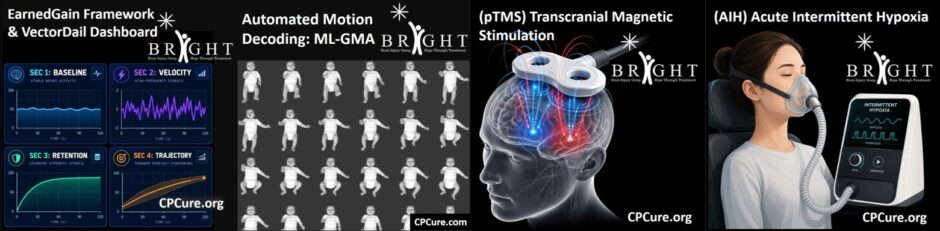
| Measurement Engine | EarnedGain Framework | Tracks the live interaction of structural, mechanical, and physiological constraints to confirm systemic phase transitions. |
| Control Portal | VectorDial Dashboard | Decentralizes complex kinematic data into an honest speedometer for caregivers. |
** BRIGHT and CPCure are proud to announce a strategic MOU with Peking University International Hospital (PKUIH) **
Seeking a Functional Cure:
BRIGHT is unapologetically focused on a “Functional Cure”. By choosing this specific language we Set a Higher North Star: It forces researchers & clinicians to look for regenerative and restorative outcomes rather than just better wheelchairs or braces. It signals to donors and scientists that BRIGHT is interested in “moonshot” engineering, not just standard clinical care. BRIGHT is designing an exit strategy from the entire industry of “managing” disability. While the legacy charities are busy with the “business of CP,” BRIGHT is focused on the obsolescence of CP.
Scientific Excellence – BRIGHT SAB:
BRIGHT’s Scientific Advisory Board consists of the literal architects of the field—the people who discovered the laws of neuroplasticity—it moves BRIGHT from being a “hopeful non-profit” to being the Intellectual Source Code for the entire field. BRIGHT does not have to wait for the “gatekeepers” because our SAB (Merzenich, Hogan, Taub) are the very people the gatekeepers quote.
- Mike Merzenich, PhD: Widely considered the father of brain plasticity.
- Ed Taub, PhD: Developer of Constraint-Induced (CI) Therapy, the gold standard for neuro-rehab.
- Michael V. Johnston, MD: Former Chief Medical Officer at the Kennedy Krieger Institute.
From Static “Tollgate” Medicine to High-Velocity Frontier Science
BRIGHT and CPCure is proud to announce a strategic MOU with Peking University International Hospital (PKUIH), bridging elite clinical infrastructure with the next generation of AI-driven neuro-rehabilitation. Through our strategic partnership with Peking University International Hospital (PKUIH) as well as other global collaborations, BRIGHT is advocating to bridge the gap between frontier neuroscience and clinical application. We are not a clinic; we are a medical think tank demanding a paradigm shift in how the world treats chronic brain injury.
The Paradigm Shift: Why “Wait-and-See” is Obsolete:
For decades, Cerebral Palsy and neuro-developmental care have been defined by “Legacy” approaches: subjective snapshots (GMFCS), systemic suppression (Botox/Baclofen), and irreversible surgeries (SDR).
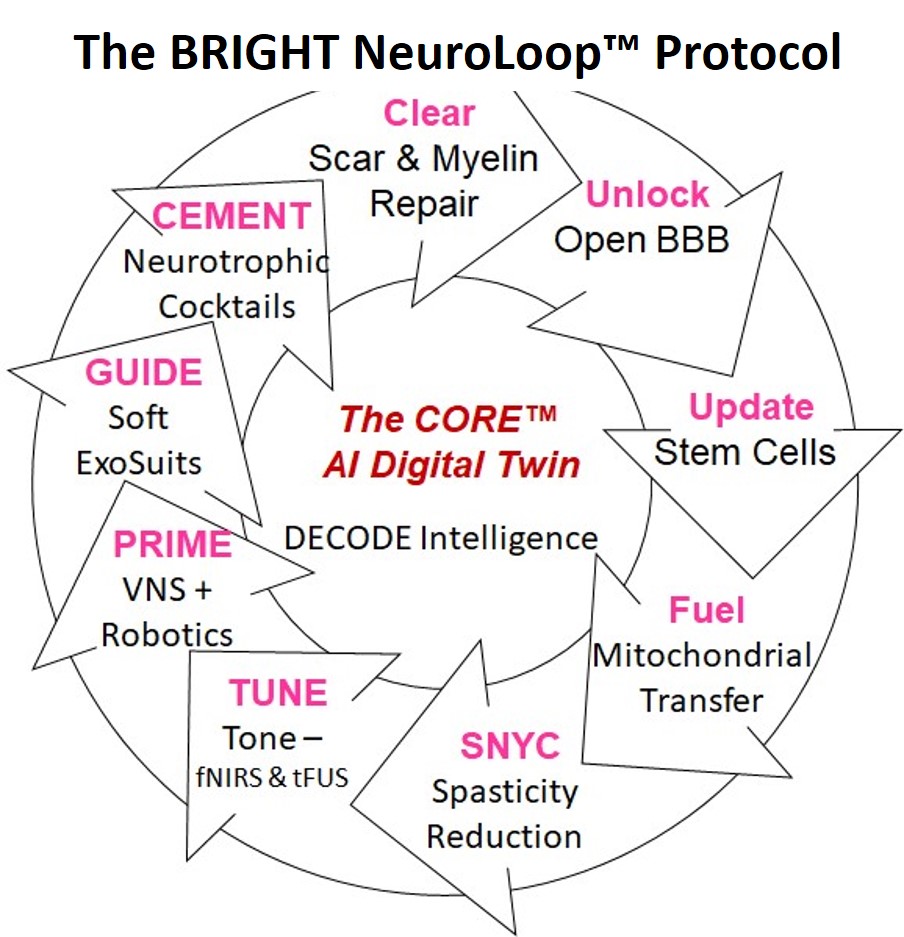
The NeuroLoop Protocol is a Global Standardized Methodology for HIE restoration. It is an Applied Synthesis of the foundational work of our Scientific Advisory Board. By moving beyond static treatment models into Adaptive N-of-1 Precision, the Protocol provides a Multimodal Sequence—incorporating cellular catalysts and AI-driven feedback—to accelerate the path to a functional cure.
The NeuroLoop Protocol challenges the medical community to replaces these static and sometimes destructive approaches with non-invasive, high-velocity solutions. The protocol leverages the Frontier of Neuro-Physics to repair, rewire, and reinforce the human connectome.
Every week, BRIGHT reviews the latest cerebral palsy and brain injury research from NCBI PubMed and Entrez databases. We call this process the BRIGHT Horizon Filter (previously the Meta-Study). We categorize each study into the ten NeuroLoop Protocol Domains and evaluate its impact: Additive, Supportive, or Legacy. New “Additive” research is instantly integrated, ensuring the NeuroLoop Protocol remains the global gold standard for neuro-rehabilitation. Supportive studies validate existing methods, and Legacy studies evaluate the current standard care with little to no impact on neuro-repair.
The 10 Steps of the BRIGHT NeuroLoop Protocol
STEP ZERO – The NeuroLoop Stability Index
The goal of STEP ZERO is to quiet down the background stress in the lungs and gut, creating a stable baseline so the brain is actually ready for neuroplastic learning.
- DECODE – Intelligence: The CORE an AI Digital Twin
Legacy: Subjective GMFCS snapshots and goniometry.
Frontier: The protocol utilizes Connectome Mapping DTI, Magneto-Electric Nano Particles (MENPs), and biomarkers to build a digital AI Twin of the brain. Through Lesion Network Mapping (LNM), it shifts the focus from “where is the hole?” to identifying “which circuit can we focus on?” to restore function. More specifically, The NeuroLoop CORE is the proprietary analytics layer of this protocol. The CORE does not re-wire the brain; it executes real-time, edge-computed biometric telemetry to map the patient’s individual structural connectome. It exposes unallocated neural oppertunity and identifies precisely where motor intent signals drop, generating the exact target needed for our active therapeutic phases to execute high-dosage re-wiring.
2. CLEAR – Repair: Targeted Biological Restoration
Legacy: Systemic medications like Baclofen that cause global CNS suppression.
Frontier: The protocol targets the root cause. By focusing on Myelin Repair (OPC) and glial scar enzymes, it restores signal speed and clears the physical barriers preventing neural communication.
3. UNLOCK – The Gateway: Opening the Blood-Brain Barrier (BBB)
Legacy: Oral or IV delivery systems, of which 98% is blocked by the BBB.
Frontier: Using MENPs (Magneto-Electric Nano Particles) or Focused Ultrasound (FUS) + Microbubbles, the protocol achieves a targeted, temporary, and reversible opening of the BBB, ensuring neurotrophic factors reach the exact coordinates required.
4. UPDATE – Hardware/Software: Biological Updates
Legacy: Passive observation of failure.
Frontier: Stem Cells (MSC/UCB) use paracrine signaling to heal and grow back damaged brain tissue, creating a blank slate of new cells. Focused training then steps in to program these fresh cells with new skills.
5. FUEL – Energy: Replacing the Broken Engines
Legacy: Standard HBOT protocols.
Frontier: The protocol combines Intranasal Mitochondrial Transfer with HBOT. It doesn’t just provide high-octane fuel (Oxygen); it replaces the broken engines (Mitochondria) themselves.
6. SYNC – Spasticity: Real-Time Signal Modulation
Legacy: SDR (Rhizotomy)—irreversible nerve severing.
Frontier: Closed-Loop tSCS / eSCS. The protocol utilizes AI-driven, real-time spinal cord modulation to manage signals without permanent, destructive surgery.
7. TUNE – Tone Management: Deep Circuit Tuning
Legacy: Botox or ITB Pumps that dampen the system chemically.
Frontier: tFUS (Focal Ultrasound) & (tPBM/fNIRS) A non-invasive “tuning fork” for deep brain circuits, allowing for precise tone management without systemic side effects.
8. PRIME – Plasticity: The Synergy Phase
Legacy: Low-dose, labor-intensive manual physical therapy.
Frontier: Paired VNS + Robotics + VR. The protocol uses Vagus Nerve Stimulation to “tag” circuits for growth during execution. This is supported by the EchoIntent Verbal Generator, which bio-hacks the environment to raise BDNF and lower systemic inflammation.
9. GUIDE -Structure: Preserving the Niche
Legacy: Tenotomy or bony surgeries that cut tissue to fit contractures.
Frontier: Soft Robotics & Exoskeletons. These technologies preserve muscle length and protect stem cell niches, allowing the body to grow into its new functional capabilities.
10. CEMENT – Metabolic: Cementing the Connections
Legacy: Non-specific caloric intake.
Frontier: Neurotrophic Cocktails (BDNF/GDNF). The protocol saturates the system with growth factors to “cement” the new synaptic connections made during the robotics and plasticity phases.
Global Authority. Scientific Integrity.
The collaboration with Peking University International Hospital ensures that the NeuroLoop is backed by rigorous data, massive clinical volume, and a success-first regulatory environment.
- Evidence-Based: Every phase of the NeuroLoop correlates with or leads emerging peer-reviewed research in neuroplasticity and regenerative medicine.
- Safety First: NeuroLoop prioritizes non-invasive interventions that preserve the body’s structural integrity.
BRIGHT has created a database of existing published research, we call this the BRIGHT Horizon Filter (previously the Meta-Study). This data bank includes research in basic brain biology, treatment methods, therapeutic methods, engineering, and technology. Our CP Meta-Study is updated on a weekly basis and ensure that BRIGHT’s NeuroLoop Protocol stays at the absolute cutting edge of global research. If any new innovations are published or theorized, BRIGHT updates the protocol weekly.
The “CP Repository“ is a legacy project. It was a large-scale collection of data from our members with Cerebral Palsy, TBI, and other related brain injuries. We make this data available to researchers studying CP and other similar diseases. The BRIGHT CP Repository and the BRIGHT CP Meta-Study aggregate the results of existing studies and live data from our membership, so that collectively they can be analyzed and help lead to new findings and breakthroughs.
While The CP Repository is an important legacy project, BRIGHT has moved on to the NeuroLoop Protocal CORE: Individualized Closed-Loop AI. This system operates on the principle that the most relevant data for a patient’s recovery is not found in a textbook or a distant repository, but in their own real-time biological and functional responses.
- Continuous Local Training: Unlike traditional AI that relies on pre-trained static models, CORE is designed to be a “living” model. It utilizes multi-modal inputs—such as wearable sensor data, movement tracking, and sometimes neuro-feedback—to create a “Digital Twin” of the individual’s specific motor and cognitive patterns.
- Edge Computing & Privacy: Because the AI is trained on “individual daily activity,” it utilizes local processing (edge computing). This allows the system to respond with low latency to a patient’s movements or needs while keeping sensitive biometric data private and localized.
- The “Loop” in Action: The system is envisioned to identify “failed” motor intents (e.g., a hand not reaching a target) and uses AI to immediately adjust the next intervention—whether that’s a specific frequency of neurostimulation or a robotic assist—to “close the gap” between the intent and the action.
- By prioritizing the CORE system over the repository, CPCure is betting on Neuro-Adaptation. It solves the heterogeneity problem by essentially becoming a bespoke therapist that is “on” 24/7. Instead of looking for a one-time surgical or chemical fix, the NeuroLoop CORE system aims to “engineer” a recovery by constantly nudging the brain toward neuroplasticity through millions of tiny, individualized corrections every day vs macro 45 minute sessions seen in traditional rehab. Eventually BRIGHT advocates for the the CORE Framework to become a wearable framework that patients use autonomously at home.
- Are you a“disruptive philanthropist”? Help fund our World Changing Project. Donate
Further Collaborations:
BRIGHT collaborates with a wide spectrum of partners, sponsors, and allies including:
Ready to move beyond the “Wait-and-See” model?
[Explore the NeuroLoop Protocol] | [Contact Our Team]
Get involved: We invite you to make a donation, participate in one of our events, sign up for our Face Book Group, and enroll in the CP Repository. We also hope you will learn more about us and the impact we’re having on CP research.
Our organization is transparent and accountable with your donations. Click to see BRIGHT’s GuideStar Report.