 Fecal Calprotectin as a GI Biomarker
Week 17, 2026. This week Study #10 (PMID: 41985472), is additive to DECODE by introducing fecal calprotectin as a non-invasive biomarker for detecting subclinical gastrointestinal inflammation in children with CP, enhancing the NeuroLoop Protocol’s Metabolic and Gut Health domain. See more below…
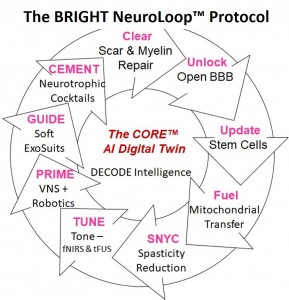
Every week, BRIGHT reviews the latest cerebral palsy and brain injury research from NCBI PubMed and Entrez databases. We categorize each study into the ten NeuroLoop Protocol Domains and evaluate its impact: Additive, Supportive, or Legacy. New “Additive” research is instantly integrated, ensuring the NeuroLoop Protocol remains the global gold standard for neuro-rehabilitation. Supportive studies validate existing methods, and Legacy studies evaluate the current standard care with little to no impact on neuro-repair.
Executive Summary: Week 17 Meta-Analysis:
This Week 17 meta-analysis synthesizes 30 unique, independent research studies from global databases, filtering them through the BRIGHT NeuroLoop framework. Our analysis identifies 4 ‘Additive’ breakthroughs—including a new GI biomarker (Study #10) and a mobile screening app (Study #16)—while highlighting critical research gaps in the FUEL and UPDATE domains
- DECODE (Digital Twin): This is where 2026 research is strongest. We are getting better at “mapping” the damage (MRI, Genomics, 3D modeling), but mapping is not curing.
- SYNC / TUNE (High-Velocity Loops): These are supported by therapy papers (#4, #6, #7, #15), but they still lack the “closed-loop” automation of the BRIGHT protocol.
- UPDATE (Neuro-Interfaces): The only “Update” research here (#13, #17) is invasive. There is a gaping hole in this list for non-invasive “Update” technologies like FUS or Nanoparticles.
- FUEL / UNLOCK (Cellular Catalysts/Epigenetics): These domains are almost entirely absent from this list. The scientific community is still largely ignoring the metabolic and cellular “Fuel” required for the brain to actually rebuild.
Key Insight: Lack of focus on UPDATE and FUEL domains
BRIGHT NeuroLoop Protocol Additive Research: Week 17, 2026
Mobile App for Hip Migration Screening
Study #16 (PMID: 41983275), is additiveto DECODE by decentralizing hip surveillance through a validated mobile app for community-based screening, allowing for earlier detection of hip migration. This expands the NeuroLoop’s Orthopedic Integrity domain by integrating accessible, parent-led digital monitoring tools to prevent secondary complications in underserved populations.
Genome/RNA Sequencing for Diagnostic Precision
Study #26 (PMID: 41981504), Genome/RNA Sequencing for Diagnostic Precision, is additive to DECODE by utilizing advanced multi-omic sequencing to uncover specific genetic drivers of cerebral palsy. This enhances the NeuroLoop Protocol’s Precision Medicine domain, allowing for more targeted, individualized neuro-rehabilitation strategies based on a patient’s unique molecular profile rather than just clinical symptoms.
Fecal Calprotectin as a GI Biomarker
Study #10 (PMID: 41985472), is additive to DECODE by introducinng fecal calprotectin as a non-invasive biomarker for detecting subclinical gastrointestinal inflammation in children with CP, enhancing the NeuroLoop Protocol’s Metabolic and Gut Health domain. By providing a measurable biological target, this study enables more precise nutritional and inflammatory management within the protocol.
Individualized BCI Electrode Subsets
Study #18 (PMID: 41971353), Individualized BCI Electrode Subsets, is additive to TUNE as it demonstrates that individualized electrode subsets improve BCI accuracy, advancing personalized neural mapping within the Assistive Technology domain for non-verbal patients. This is additive as it optimizes communication interfaces, directly increasing the efficiency of neuro-plasticity-based interventions for those with severe motor impairments.
Week 17 Citations Sorted by BRIGHT NeuroLoop Protocol Domain and their status within the Protocol (Additive, Supportive, or Legacy).
| Index | Domain | Short Title / Focus | Status | BRIGHT Context |
| 17-26:16 | DECODE | HipScreen Mobile App | Additive | New Tool: High-frequency structural data for the Twin. |
| 17-26:26 | DECODE | Genome & RNA Sequencing | Additive | New Data: Molecular-level precision for decoding. |
| 17-26:1 | DECODE | Triceps Muscle Architecture | Supportive | Personalized musculoskeletal modeling for the Digital Twin. |
| 17-26:3 | DECODE | 3D Hip Reconstruction Planning | Supportive | Static structural mapping for orthopedic alignment. |
| 17-26:25 | DECODE | Adult Cognition Review | Supportive | Establishes the cognitive baseline for adult Digital Twins. |
| 17-26:29 | DECODE | Preterm Outcomes (No CP) | Supportive | The “Healthy Blueprint” for comparative Twin modeling. |
| 17-26:30 | DECODE | Kidokoro MRI Scores | Supportive | Early structural biomarkers for neonatal Decoding. |
| 17-26:12 | DECODE | Proxy-reported Pain Interference | Legacy | Subjective data; lacks the objective neural stream of a Twin. |
| 17-26:10 | CLEAR | Fecal Calprotectin (GI) | Additive | New Sensor: Clearing inflammatory barriers to plasticity. |
| 17-26:11 | CLEAR | Polypharmacy in Adults | Legacy | Identifies the “chemical noise” that must be Cleared. |
| 17-26:- | UNLOCK | No citations found in this list | GAP | Missing: Epigenetic or non-viral gene-expression tools. |
| 17-26:13 | UPDATE | China’s Brain Chip | Legacy | Invasive hardware; BRIGHT avoids this for non-invasive. |
| 17-26:17 | UPDATE | Implantable BCI Review | Legacy | Invasive hardware; incompatible with BRIGHT principles. |
| 17-26:- | FUEL | No citations found in this list | GAP | Missing: Cellular catalysts, mitochondrial, or metabolic optimization. |
| 17-26:4 | SYNC | Intensive Therapy & Grip | Supportive | Validates intensive firing loops for motor control. |
| 17-26:6 | SYNC | Telerehabilitation Review | Supportive | Validates remote delivery of high-frequency Sync loops. |
| 17-26:14 | SYNC | Exoskeleton Physiotherapy | Supportive | Mechanical actuators providing external sensory Sync. |
| 17-26:15 | SYNC | Video Game Exercises | Supportive | Gamified engagement to maintain loop repetition. |
| 17-26:18 | TUNE | BCI Calibration Logic | Additive | New Logic: Real-time Tuning of the brain-machine loop. |
| 17-26:7 | TUNE | Exercise Dose Meta-analysis | Supportive | Seeking the “Optimal Frequency” for intervention. |
| 17-26:9 | PRIME | Vaccination & Neuro-outcomes | Supportive | Baseline immune state related to systemic Priming. |
| 17-26:5 | GUIDE | Environmental Supportiveness | Legacy | Focuses on lifestyle, not the internal neuro-pathway. |
| 17-26:8 | GUIDE | CP Football / Clean Sport | Legacy | Sociological management of the patient’s identity. |
| 17-26:19 | GUIDE | Goal-Setting System | Legacy | Qualitative framework for standard clinical management. |
| 17-26:20 | GUIDE | Indonesia Rehab Survey | Legacy | Identifies global gaps in traditional clinical Guidance. |
| 17-26:21 | GUIDE | Social Determinants of Health | Legacy | Macro-level barriers to standard care delivery. |
| 17-26:22 | GUIDE | Caregivers in Ethiopia | Legacy | Documents the burden of the legacy Guidance model. |
| 17-26:23 | GUIDE | Swedish Housing & Personal Asst. | Legacy | Management of living with disability (Status Quo). |
| 17-26:24 | GUIDE | Societal Cost Prediction | Legacy | Economic analysis of managing rather than Curing. |
| 17-26:27 | GUIDE | Perceptions of the Body | Legacy | Qualitative psychology; no impact on neuro-repair. |
| 17-26:28 | GUIDE | Knowledge Translation | Legacy | Research on how to teach old legacy methods better. |
| 17-26:2 | CEMENT | Multilevel Surgery Outcomes | Legacy | Structural “fixing” that ignores neural Cementing. |
Full Citation List
| Index | Citation |
| 17-26:1 | 1.Triceps surae muscle architecture in ambulant children with cerebral palsy: architectural adaptations vary between children and muscles Bart Bolsterlee, Brian V Y Chow, Suzanne Davies, Catherine Morgan, Caroline D Rae, David I Warton, Iona Novak, Ann Lancaster, Gordana C Popovic, Mahsa Seydi, Claudia Y Rizzo, Iain K Ball, Robert D Herbert Journal of Biomechanics. 2026 Apr 10; Online ahead of print PMID: 41996992 |
| 17-26-2 | 2.Biomechanical and functional outcomes of high-burden and low-burden multilevel surgery in young people with cerebral palsy No authors listed Developmental Medicine & Child Neurology. 2026 Apr 17; Online ahead of print PMID: 41996264 |
| 17-26-3 | 3.Individualized 3D Planning for Hip Reconstruction in Cerebral Palsy: Study Protocol Britta K Krautwurst, Thomas Dreher, Franziska L Hatt, Bastian Sigrist, Tobias Götschi, Domenic Grisch Journal of Clinical Medicine. 2026 Mar 30 PMID: 41976937 |
| 17-26:4 | 4.Effects of an intensive therapy on the precision grip control while walking down a step in children with unilateral cerebral palsy: a self-controlled study Daniela Ebner-Karestinos, Rodrigo Araneda, Geoffroy Saussez, Carlyne Arnould, Jean-Louis Thonnard, Yannick Bleyenheuft Experimental Brain Research. 2026 Apr 13 PMID: 41973125 |
| 17-26-5 | 5.Environmental supportiveness, physical activity, and sedentary time in children with cerebral palsy No authors listed Developmental Medicine & Child Neurology. 2026 Apr 17; Online ahead of print PMID: 41996273 |
| 17-26-6 | 6.Effects of Telerehabilitation on Gross Motor Function in Children with Cerebral Palsy: A Systematic Review Olga Maia, Daniel Moreira Gonçalves, Rui Vilarinho Healthcare (Basel). 2026 Apr 3 PMID: 41975944 |
| 17-26:7 | 7.Overall and modality-specific exercise doses for motor skill improvement in cerebral palsy: a systematic review and Bayesian network dose-response meta-analysis Qiang Xiong, Xing-Liang Duan, Peng-Wei He PeerJ. 2026 Apr 8 PMID: 41970266 |
| 17-26-8 | 8.Perspectives towards, and experiences of clean sport in international Cerebral Palsy Football: A cross-cultural qualitative exploration of players and athlete support personnel Ellie-May Storr, Carolyn R Plateau, Ailish King, Sam Turner, Janine K Coates, Jamie B Barker Psychology of Sport and Exercise. 2026 Apr 11; Online ahead of print PMID: 41967558 |
| 17-26-9 | 9.Association between vaccination status and neurodevelopmental outcomes in children with cerebral palsy Hong Zhao, Mingbo Hu, Fei Xie, Chunyu Zhang, Linli Zhang, Chao Bai, Junjie Wu, Baofeng Yan, Aikebaier Halike, Jingxuan Xu, Xinping Luan Frontiers in Pediatrics. 2026 Apr PMID: 41993894 |
| 17-26:10 | 10.Fecal Calprotectin as a Potential Biomarker of Gastrointestinal Inflammation in Children With Cerebral Palsy: A Prospective Pilot Study Ece Gültekin, Abdullah Sert, Meryem K Ba?aran Klinische Pädiatrie. 2026 Apr 15; Online ahead of print PMID: 41985472 |
| 17-26-11 | 11.Polypharmacy among adolescents and adults with cerebral palsy in a clinical setting Caitlin Cassidy, Joshua C Wiener, Karen Pratt, Laura Brunton PM&R. 2026 Apr 13; Online ahead of print PMID: 41978240 |
| 17-26-12 | 12.Construct validity, reliability, and sensitivity of proxy-reported pain interference in individuals with cerebral palsy Breanne J Byiers, Serena Chan, Frank J Symons, Chantel C Burkitt The Journal of Pain. 2026 Apr 11; Online ahead of print PMID: 41974217 |
| 17-26:13 | 13.China approves brain chip to overcome paralysis No authors listed Nature Biotechnology. 2026 Apr PMID: 41998388 |
| 17-26-14 | 14.Exoskeleton-assisted physiotherapy in school and outpatient contexts for minimally ambulant children with cerebral palsy No authors listed Developmental Medicine & Child Neurology. 2026 Apr 17; Online ahead of print PMID: 41996268 |
| 17-26-15 | 15.The effect of video game-based exercises on selective motor control, balance, fear of falling, and functional capacity in individuals with spastic cerebral palsy: A randomized controlled trial Süveybe Yava?, Sezen Tezcan Research in Developmental Disabilities. 2026 Apr 15; Online ahead of print PMID: 41990569 |
| 17-26:16 | 16.HipScreen: a valid mobile app to measure hip migration in children with cerebral palsy in the community setting Akib M Khan, John Amen, Oliver Perkins, Konstantinos Kafchitsas, Stephen J Cooke, Michail Kokkinakis, Laura Ball, Andre King, Sophie Billingham, Joel Bowpitt, Alexandra Webster, Sunita Dhindsa, Anita Patel, Lucy Clough, Ola Pieno, Beckie Corps, Rachel Heayberd, Suzi Davenport, Claire Wicks, Jill Cadwgan Bone & Joint Open. 2026 Apr 15;7(4) PMID: 41983275 |
| 17-26-17 | 17.Review of Recent Advances in Implantable Brain-Computer Interfaces for the Restoration of Motor Function in Patients With Paralysis Daokai Yang, Xiaogang Liu, Junhang Hu, Wei Zhang Medical Science Monitor. 2026 Apr 14 PMID: 41978246 |
| 17-26-18 | 18.Individualized electrode subset improves the calibration accuracy of an EEG P300-design brain-computer interface for people with severe cerebral palsy Si Long Jenny Tou, Seth A Warschausky, Petra Karlsson, Jane E Huggins Frontiers in Human Neuroscience. 2026 Mar 26 PMID: 41971353 |
| 17-26:19 | 19.Psychometric Properties of Turkish Version of Perceived Efficacy and Goal-Setting System Gokcen Akyurek, Rumeysa Gunal Gunser, Rukiye Begum Koca Senturk OTJR: Occupation, Participation and Health. 2026 Apr 16; Online ahead of print PMID: 41992758 |
| 17-26-20 | 20.Rehabilitation and dosing practice for individuals with cerebral palsy in Indonesia: a survey of physiotherapists and occupational therapists Suci Anatasia Nazier, Elizabeth Maus, Sara Tafone, Satria Ardianuari, Jill Heathcock Disability and Rehabilitation. 2026 Apr 16; Online ahead of print PMID: 41989062 |
| 17-26-21 | 21.The Effect of Social Determinants of Health on Health Care Delivery for Children With Cerebral Palsy in the US Health Care System: A Scoping Review Kathryn Radulovacki, Bradley Q Fox, Christian Zirbes, Rachelle Shao, Evelyn Hunter, Summer Shabana, Muhamed Sanneh, Devika A Shenoy, Stephanie Hendren, Anthony A Catanzano Journal of Developmental & Behavioral Pediatrics. 2026 Mar-Apr;47(2) PMID: 41985009 |
| 17-26:22 | 22.”It Feels Like My Spine is About to Break”: Experience and support needs of family caregivers of children with cerebral palsy in Ethiopia Melkitu Melak, Solomon Mekonnen, Afolasade Fakolade, Beata Batorowicz PLoS One. 2026 Apr 13 PMID: 41973687 |
| 17-26-23 | 23.Housing and need for personal assistance in relation to hand function: a cross-sectional study of 2304 Swedish adults with cerebral palsy Katina Pettersson, Jenny Hedberg-Graff, Anna Lindgren, Evgenia Manousaki, Erika Cloodt, Elisabet Rodby-Bousquet Disability and Health Journal. 2026 Apr 9; Online ahead of print PMID: 41966963 |
| 17-26-24 | 24.Individual-level prediction models of societal costs and health-related quality of life in pediatric cerebral palsy: a population-based study from Spain Diana Marcela Nova Díaz, Paloma Arana-Rivera, Eduardo Sánchez-Iriso, Sergio Aguilera-Albesa, Diego Rivera Cost Effectiveness and Resource Allocation. 2026 Apr 11; Online ahead of print PMID: 41965720 |
| 17-26:25 | 25.Cognition in adults with cerebral palsy: A systematic review Kanishka Baduni, Brittany Perry, Seth Warschausky, Nathalie L Maitre, Adult CP Clinical Practice Guideline Working Group Developmental Medicine & Child Neurology. 2026 Apr 17; Online ahead of print PMID: 41996399 |
| 17-26-26 | 26.Integrating genome and RNA sequencing to enhance diagnostic precision in cerebral palsy Liuyang Zhang, Yiran Xu, Yanqiu Liu, Yongyi Zou, Hui Xiao, Lingling Zhang, Dengna Zhu, Yanan Wu, Xiaoli Zhang, Mirigul Maymaytiniyazi, Bicheng Yang, Changlian Zhu, Tingting Huang BMC Pediatrics. 2026 Apr 14; Online ahead of print PMID: 41981504 |
| 17-26-27 | 27.Perceptions of the Body in Cerebral Palsy: Voices of Family Caregivers Mariana Cristina Palermo Ferreira, Érica Cesário Defilipo, Lélia Cápua Nunes, Pedro Henrique Berbert de Carvalho Healthcare (Basel). 2026 Apr 7 PMID: 41975969 |
| 17-26:28 | 28.Advancing knowledge translation processes in motor rehabilitation for children with cerebral palsy and developmental coordination disorder: insights from a scoping review Léa Obrecht, Femke van Abswoude, Katrijn Klingels, Bert Steenbergen BMC Health Services Research. 2026 Apr 11; Online ahead of print PMID: 41965646 |
| 17-26-29 | 29.Motor skills and outcomes of activities and participation in children and adults born preterm without cerebral palsy: A systematic review No authors listed Developmental Medicine & Child Neurology. 2026 Apr 17; Online ahead of print PMID: 41996263 |
| 17-26-30 | 30.Concordance and Association of Kidokoro MRI Scores at 32 and 40 weeks post-menstrual age with Neurodevelopmental Outcomes in Very Preterm Infants Linda Bonezzi, Tommaso Biagioni, Simona Fiori, Carly Luke, Joanne M George, Paul B Colditz, Jurgen Fripp, Robert S Ware, Kerstin Pannek, Roslyn N Boyd AJNR American Journal of Neuroradiology. 2026 Apr 15; Online ahead of print PMID: 41986144 |
Creator Credentials
- Founder, BRIGHT Foundation: Leading a global initiative to “close the loop” on Cerebral Palsy recovery through data-driven research.
- 25+ Years Lived Experience: Navigating life with a daughter with CP provides a primary, first-person understanding of the physiological and clinical gaps in current care models.
- GE Alumnus & Business Leader: Leveraging decades of experience in operational excellence, complex systems, and strategic leadership to apply rigorous meta-study frameworks to neurological research.
- Methodology: Combines personal advocacy with professional systems-thinking to synthesize NCBI PubMed data into the actionable NeuroLoop Protocol.
Conflict of Interest Statement
- Non-Profit Mission: Our objective is purely research-driven, aimed at identifying the most effective paths to a functional cure.
- Independence: No funding is received from manufacturers of the devices or therapies reviewed in our weekly meta-studies.
- Transparency: All citations are linked directly to PubMed (PMIDs) to ensure users can verify the raw data independently.