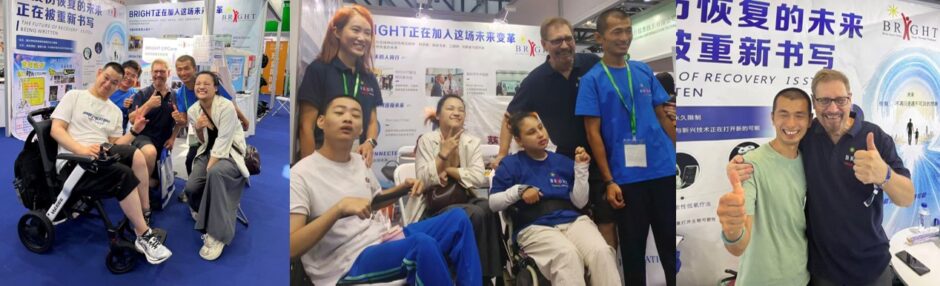
More than 20 years ago, BRIGHT convened its first Scientific Advisory Board meeting in San Francisco at the American Academy of Neurology/Society of Neuroscience Meeting. While some joined from across the globe via teleconference, the Founder’s vision was clear: bring together disparate disciplines—Neuroscience, engineering, computer tech, and clinical rehab—that rarely, if ever, occupied the same room.
At that time, they were known experts; fast forward to today, and those original SAB members are the foundational icons of their fields. Names like Michael Merzenich, the father of neuroplasticity; Neville Hogan, the pioneer of robotic-assisted therapy; and Edward Taub, the inventor of the gold standard in stroke rehab, Constraint-Induced Therapy. This was not a random gathering; it was a highly curated assembly of “best-in-class” talent.
To build on this lineage, the BRIGHT Foundation has developed the BRIGHT Horizon Leadership Board (HLB). This is a select group of Upcoming Legends—the next generation of architects for human potential. While the BRIGHT SAB remains the “Hall of Founders” who established our first principles, the BRIGHT HLB Fellows are actively building on that foundation every day. These individuals serve as our Translational Legends. They are the essential bridge, taking deep, evolutionary science and refining it into action, such as BRIGHT’s NeuroLoop Protocol.
In joining the HLB as BRIGHT Horizon Fellows, these leaders do more than advise; they actively step into a lineage of succession. As their breakthroughs become part of the foundational history of neurology, their trajectory leads them naturally toward membership in the BRIGHT Scientific Advisory Board—ensuring the mission remains as kinetic and vital as the brain itself.
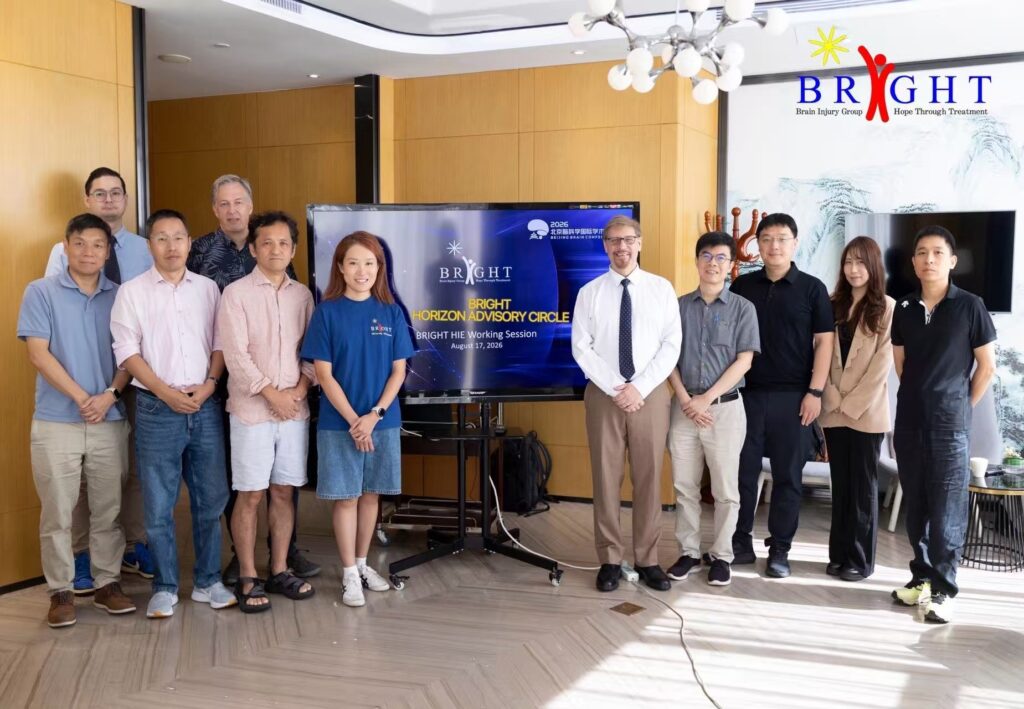
Here is a Press Release of the first BRIGHT Horizon Leadership Board (HLB) Meeting. Held on August 17th, 2026 immediately following the internationally focused 2026 Beijing Brain Conference co-hosted by CIBR/Nature.
Read the full Press Release:
First BRIGHT Horizon Leadership Board (HLB) Meeting press release
(Chinese Version) First BRIGHT Horizon Leadership Board (HLB) Meeting
BRIGHT also presented a peer-reviewed poster, introducing its abstract titled “Beyond Top-Down Control: Operationalizing Connectome Circuits for HIE Restoration via The NeuroLoop Protocol”. The poster introduced BRIGHT’s ongoing thinking around long-term functional recovery in HIE/CP, translational neuroscience, and The NeuroLoop Protocol, a neuro-rehabilitation framework currently being explored by BRIGHT.
Dr. Luo Minmin
- Title: Co-Director and Distinguished Research Fellow, Chinese Institute for Brain Research (CIBR); Principal Investigator, National Institute of Biological Sciences (NIBS)
- Location: Beijing, China
- The BRIGHT Outside-In Fit: Directing non-invasive peripheral stimulation requires an immaculate understanding of internal brain states. Dr. Luo’s work mapping neuromodulatory pathways guides The Neuroloop Protocol to deliver stimulation precisely when central reward and plasticity windows are fully receptive.
- Global Focus: Globally recognized for deciphering the precise neural circuit mechanics governing rewards, punishments, and dorsal raphe serotonergic pathways.
Dr. Don Cleveland
- Title: Professor and Chair of Cellular and Molecular Medicine, University of California San Diego (UCSD)
- Location: San Diego, California, USA
- The BRIGHT Outside-In Fit: Implementing a continuous 24/7 dosing paradigm demands a highly resilient cellular foundation. Dr. Cleveland’s research dictates how the protocol manages long-term cellular health, ensuring the underlying neural substrate survives and adapts to chronic peripheral inputs without degradation.
- Global Focus: Winner of the Breakthrough Prize in Life Sciences; world-renowned for discovering the mechanisms of axon growth and the specific cellular pathways driving ALS and neurodegenerative diseases.
Dr. Stephen Scott
- Title: Professor of Biomedical and Molecular Sciences, Queen’s University
- Location: Kingston, Ontario, Canada
- The Outside-In Fit: Translating variable neural signals into real-time therapeutic inputs requires an absolute mastery of limb dynamics. Dr. Scott’s mathematical quantification of motor commands allows The Neuroloop Protocol to understand how voluntary intent translates across complex mechanical environments.
- Global Focus: The inventor of the KINARM exoskeleton, the world’s premier robotic tool for assessing human objective sensorimotor brain function and feedback control loops.
Dr. Vincent Cheung
- Title: Associate Professor, School of Biomedical Sciences, The Chinese University of Hong Kong (CUHK)
- Location: Hong Kong
- The Outside-In Fit: Personalizing a completely non-invasive n-of-1 therapeutic protocol depends on decoding movement without invasive brain visualization. Dr. Cheung’s frameworks allow The Neuroloop Protocol to read peripheral electromyography patterns as natural, bundled commands.
- Global Focus: Pioneer in the computational discovery and mapping of “muscle synergies”—the intrinsic neuromuscular code the central nervous system uses to simplify complex motor coordination.
Dr. Alexander Gail
- Title: Professor for Sensorimotor Research, German Primate Center and Göttingen University
- Location: Göttingen, Germany
- The Outside-In Fit: To close a non-invasive loop, sensors must catch a patient’s movement intention before the actual physical response occurs. Dr. Gail’s models map the precise predictive windows of sensorimotor planning, guiding where and when peripheral architecture catches early cognitive intent.
- Global Focus: Landmark work on posterior parietal cortex dynamics, demonstrating how abstract behavioral rules and sensory representations transform into physical, goal-directed reaching.
Dr. Kazuhiko Seki
- Title: Director, Department of Neurophysiology, National Institute of Neuroscience (NCNP)
- Location: Tokyo, Japan
- The Outside-In Fit: Bypassing central damage completely from the outside requires navigating natural spinal and sensory feedback networks. Dr. Seki’s research on sensory gating provides the manual for exactly where and how The Neuroloop Protocol can introduce external therapeutic inputs into active spinal loops.
- Global Focus: Discovering that the spinal cord acts as an active, smart preprocessing gateway that filters and shapes somatosensory feedback during voluntary movement, rather than serving as a passive relay.
Dr. Sui Yanan
- Title: Associate Professor of National Engineering Laboratory for Neuromodulation, Tsinghua University
- Location: Beijing, China
- The Outside-In Fit: Translating complex biology into highly personalized, autonomous medical paradigms requires advanced machine learning. Dr. Sui’s optimization algorithms provide the exact mathematical engine required to dynamically tailor The Neuroloop Protocol’s parameters based on real-time feedback data.
- Global Focus: Pioneering machine learning algorithms (such as safe Bayesian optimization) utilized to automate and safely optimize closed-loop neuromodulation parameters for individual patients.
Interested in becoming a BRIGHT Horizon Fellow? Contact BRIGHT for more information at matt@brightfoundation.org