Diaphragmatic Manual Therapy Executive Summary:
Diaphragmatic Manual Therapy is gaining recognition via 2026 clinical trails (Karamancıoğlu et al.) as a vital tool for structural restoration in brain injuries like Cerebral Palsy. However, viewing manual tissue remodeling as a standalone cure is a systemic error. This analysis audits the historical foundations of this technique through Advanced Biomechanical Rehabilitation (ABR) and explains why physical hardware changes fail without simultaneous active guiding for neurological rewiring.
Archival Commentary: The 2002/2003 Leonid Blyum Audit
Author: Matt Palaszynski
Context: This note preserves a pivotal historical meeting that occurred shortly after BRIGHT’s January 2002 Manifesto was published online. While the original manifesto outlines the early theoretical foundation of what is now the NeuroLoop Protocol, this interaction exposed the systemic fragmentation—and the deeply human needs—that shaped early pediatric rehabilitation.
“Shortly after publishing the 2002 Manifesto, I personally met with Leonid Blyum, the founder of Advanced Biomechanical Rehabilitation (ABR). I was introduced to him by a UK parent named David. On paper, Leonid’s focus on the structural integrity, volume, and hydraulic internal pressure of the trunk and diaphragm aligned with the Dynamic Systems Theory (DST) models I had synthesized from Esther Thelen and Beverly Ulrich. While mainstream medicine at the time was heavily focused on functional, top-down movement, Blyum understood that the brain injury was not only impacting large visible muscles, but also the internal facia like the diaphragm. The critical importance of this realization (as stated in Step ZERO of the NeuroLoop Protocol) was not obvious to mainstream treatment protocols of 2002 and quite frankly still faces editorial criticism in 2026.
However, looking at his work through a global systems-engineering lens, a critical limitation was instantly apparent: ABR was dealing with exactly 1/10th of a solution, but its business model and proprietary isolation required it to be marketed as the entire solution. Leonid had mapped out a vital structural prerequisite—what BRIGHT eventually codified as Step Zero—but he completely sidelined the active nervous system, sensory mapping, and active motor-unit recruitment championed by thinkers like Mike Merzenich and Ed Taub. In a dynamic system, if you manually remodel physical tissue without simultaneously rewiring the brain’s sensory-motor map, the body simply optimizes around the new shape and creates a different abnormal stable attractor. The physical volume improves, but the functional utility stays locked. I confronted Leonid with this reality in 2002, explaining that his mechanical insights needed to be integrated into a larger, open-source neurological loop to truly achieve functional breakthroughs. Unfortunately we parted ways and an opportunity for synergy was lost.
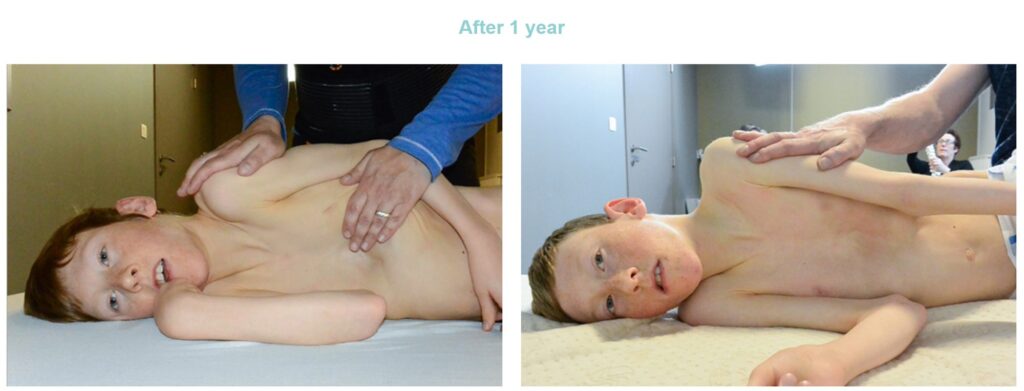
Image reproduced from: https://abrtherapy.com/results-non-walking
Yet, looking back through the eyes of parents like David, we must give Leonid credit for something BRIGHT could not provide in 2002: an actionable, physical interaction with your child. To a parent facing a devastating diagnosis, BRIGHT’s manifesto was an intellectual dream—a blueprint for a solution we did not yet have the technology to build. Leonid gave parents something to do. For many, those grueling hours of manual compression were as much a penance as they were a solution, offering a tangible way to fight back. Because I recognized that ABR was a high-engagement, mid-to-low-impact framework, I chose not to subject Alissa to it. But I deeply respected the agency it gave to others.
Amazingly, despite BRIGHT being largely theoretical at that stage, our early community of parents remained remarkably cohesive, active, communicative, and hopeful. We were united by the shared pursuit of a complete cure. Contrast that to today, and the world has changed—and not for the better. The modern internet has fractured community spaces, and the deep, collaborative resilience of those early parent networks has largely been replaced by digital isolation, shallow engagement, and informational noise.
This historical record proves that BRIGHT was never built on wishful thinking; it was forged by aggressively auditing all methodologies, identifying their mathematical and structural limitations—which BRIGHT continues to do weekly via the Horizon Filter— while always honoring the profound human need for action that drove early pioneers like Leonid and the parents who supported them.”
A Call to Action: Seeking the System-Builders
The cohesive, fiercely intelligent parent community of 2002 has not vanished—it has simply been drowned out by the modern digital landscape.
The algorithmic internet forces families into passive consumption and isolated silos. It rewards the shallow performance of “My CP Hero Selfies” on Instagram while offering little more than platitudes and coping mechanisms. We refuse to accept that as the baseline for our children’s futures.
If you are a parent, researcher, or engineer who is tired of the noise; if you look at cerebral palsy through the lens of a complex, integrated system rather than isolated symptoms; and if you are searching for an actionable, data-driven architecture to build a functional cure—you belong here.
The 20-year wait for the technology to catch up to the blueprint is over. The fragments are finally locking into a unified loop. We need the same deep, collaborative, and unapologetically hopeful minds that built the foundations of this project 24 years ago.
Stop scrolling for comfort. Start building for a cure.
- Join the Protocol Development: Explore the current DECODE, GUIDE, and NeuroLoop updates.
- Engage with the Data: Review our weekly Horizon Filter clinical audits.
- Rebuild the Community: Connect with us directly to transition from passive observation to active, systems-level execution. email matt@brightfoundation.org
Creator Credentials
Author: Matt Palaszynski
- Founder, BRIGHT Foundation: Leading a global initiative to “close the loop” on Cerebral Palsy recovery through data-driven research.
- 25+ Years Lived Experience: Navigating life with a daughter with CP provides a primary, first-person understanding of the physiological and clinical gaps in current care models.
- GE Alumnus & Business Leader: Leveraging decades of experience in operational excellence, complex systems, and strategic leadership to apply rigorous meta-study frameworks to neurological research.
- Methodology: Combines personal advocacy with professional systems-thinking to synthesize NCBI PubMed data into the actionable NeuroLoop Protocol.
Conflict of Interest Statement
The BRIGHT Foundation and its founder, Matt Palaszynski, maintain no commercial or business interests in the medical technologies, pharmaceutical products, or clinical services discussed on this page.
- Non-Profit Mission: Our objective is purely research-driven, aimed at identifying the most effective paths to a functional cure.
- Independence: No funding is received from manufacturers of the devices or therapies reviewed in our weekly meta-studies.
- Transparency: All citations are linked directly to PubMed (PMIDs) to ensure users can verify the raw data independently.