
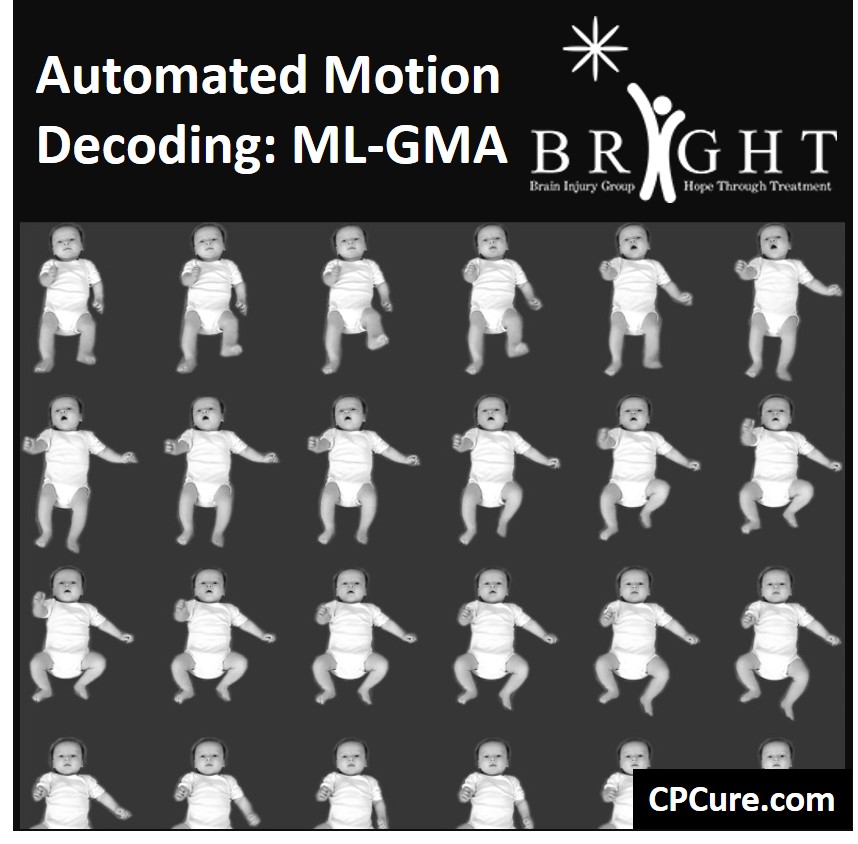
An evaluation of the Week 26, 2026 literature (19 studies) against the BRIGHT Horizon Filter™ criteria confirms zero true Additive results. However, the structural anchor of this week is a comprehensive scoping review supporting the DECODE domain: Study 11 by Kaur et al. (PMID: 42310947) “Tracking Machine Learning approaches in automated infant General Movements Assessment (ML-GMA)“.
Executive Summary: 19-Study Horizon Filter Evaluation – Week 26, June 22nd, 2026
The centerpiece of this week’s analysis is the accelerating evolution of automated markerless pose tracking in early diagnostics. This technology provides the definitive mathematical and computational validation for the software foundation underpinning the live NeuroLoop Core architecture.
While ML-GMA is clinically utilized as a predictive screening tool for early neurodevelopmental risk, the underlying technology—specifically deep learning-based markerless pose reconstruction and time-series spatial feature extraction—represents the absolute computational foundation of the NeuroLoop Core.
Traditional clinical tracking relies on subjective, slow, human visual checklists. This study maps how advanced algorithmic pipelines transform human movement analysis into objective, mathematical coordinate streams. For CPCure.com readers, this illustrates the exact software evolution that the NL Core weaponizes: transitioning passive, diagnostic tracking models into a live, closed-loop interactive interface capable of reading and reacting to human motor intent in real time. This study and technology confirms that BRIGHT’s 25 year old vision is now a technological reality.
One groundbreaking 2025 study was published in IEEE Transactions on Medical Imaging, “Facilitate Robust Early Screening of Cerebral Palsy via General Movements Assessment with Multi-Modality Co-Learning (PMID 41364569)“. This study introduces CoGMA (Collaborative General Movements Assessment). It was developed by senior clinical AI researchers and neonatologists including Tongyan Han and Wang Yin at Peking University Third Hospital (PUTH) in Beijing, China. CoGMA directly solves the data sparsity and subjective clinician limitations of traditional motion skeleton models by utilizing a multi-modality co-learning framework during training. (Read more about BRIGHT’s strategic MOU with Peking University International Hospital (PKUIH))
This process serves as the technological validation for for the BRIGHT NL Core (NeuroLoop™ Core). However, BRIGHT advances the technology an order of magnitude further. Instead of acting as a passive, “black box” predictive model that merely logs infant neuromotor deficits, the BRIGHT NeuroLoop™ Protocol shifts from diagnostics to closed-loop therapeutics. By processing digital biomarkers in real time, the NL Core can actively interact with and drive neuroplasticity in developing nervous system, transforming the static screening method into an interactive engine for a functional cure.
Predictive vs. Dynamic Evolution: While ML-GMA applies this computer-vision pipeline retrospectively to predict risk and map early spontaneous brain maturation, the NL Core takes this exact tracking architecture and turns it live and dynamic. It evolves the algorithm from an observer that scores an infant’s “fidgety movements” into an active participant that drives real-time motor intent decoding.
Study 9 (Campilii et al.) (PMID:42316377) . Multimodal engagement estimation in paediatric robot-assisted gait training: integrating physiological sensing and biomechanical interaction is actually “NULL RESULT” study. While the study is supportive in that it validates multi-modal integration with Exoskelton guidance, it is a “NULL RESULT” in that, The study’s biggest technical failure was its inability to classify the “neutral state” cleanly. They hit a wall because they tried to map a child’s deep cognitive and emotional engagement using a highly limited, lagging subset of data: just exoskeleton torque, HRV, and skin temperature.
- Why they failed: A child with CP who is staring straight ahead, working through massive proximal co-contraction just to stay upright, will display a dropped HRV (stress) and static torque. To a basic Extra Trees classifier, that looks identical to a child who has completely checked out (“not engaged”).
- Why EchoIntent bypasses this: You didn’t stop at passive physiology. EchoIntent integrates infrared eye-tracking and facial micro-expressions. If that same child is struggling physically but their scanpath history shows selective attention allocation or rapid fixation on an environmental target, EchoIntent instantly registers active intent. The academic world is trapped in the “neutral” gray zone because they are blind to the face and the eyes.
Finally, an important “NULL RESULT” study is Study 3 by Krarup et al. (PMID: 42294535) Inconsistent Weight-Bearing in Standing Frames for Children with Cerebral Palsy: A Reliability Study Using Objective Force-Plate Monitoring exposing the systemic flaws of traditional, static standing frames. Utilizing objective force-plate monitoring, the data reveals that manual positioning results in highly inconsistent skeletal weight-bearing that goes unnoticed by clinicians. Under Dynamical Systems Theory (DST), a variable biological system cannot self-optimize without precise feedback. This “NULL RESULT” study provides a definitive justification for the GUIDE domain’s architecture: showing why passive, manual equipment must be entirely replaced by automated force-feedback arrays that track and adjust loading profiles in real time to secure metabolic and bone-density health.
Week 26 Master Filter Matrix
| Status | Core Finding & Target Module | PMID / Source |
|---|---|---|
| Supportive | Study 11 (Kaur et al.) ➔ Supports UPDATE: Validates machine learning pattern recognition and markerless pose estimation for automated infant movement scoring, confirming the software foundation of the NL Core. | 42310947 |
| Supportive | Study 1 (Elnaggar et al.) ➔ Supports FUEL: Validates step-length asymmetry as a core driver of metabolic waste, backing the physiological parameters tracked by real-time energy optimization loops. | 42290112 |
| Supportive | Study 3 (Krarup et al.) ➔ Supports FUEL: Proves that manual standing frames result in highly inconsistent force distribution, validating why passive equipment must be replaced by automated force-feedback arrays. | 42294535 |
| Supportive | Study 5 (Larson et al.) ➔ Supports CLEAR: Validates that managing chemical spasticity via intrathecal pathways alters macro-structural alignment during axial spinal fusions, demonstrating secondary systemic tone effects. | 41547712 |
| Supportive | Study 9 (Campilii et al.) ➔ Supports UPDATE: Validates multi-sensor physiological telemetry fusion for tracking user engagement in robotic gait training, supporting real-time neural intent-detection layers. | 42316377 |
| Supportive | Study 10 (Zhu et al.) ➔ Supports UPDATE: Proves distinct hemispheric cortical activation and connectivity shifts during virtual tasks using fNIRS, validating targets for closed-loop plastic remodeling. | 42312193 |
| Supportive | Study 12 (Stevenson et al.) ➔ Supports UPDATE: Evaluates game engine interactive parameters to validate human-in-the-loop engagement compliance metrics. | 42206959 |
| Legacy | Study 2 (Gravholt et al.) ➔ Replaced by UPDATE: Relies on manual, longitudinal tracking of spastic walking capacity degradation in adults instead of live predictive analytics. | 42287390 |
| Legacy | Study 4 (Nie et al.) ➔ Replaced by UPDATE: Pools traditional, un-digitized macro balance training protocols that completely lack real-time sensor integration. | 42291439 |
| Legacy | Study 6 (Smith et al.) ➔ Replaced by UPDATE: Standardizes subjective, patient-reported pain interference questionnaires; bypassed by direct neuro-telemetry. | 42310144 |
| Legacy | Study 7 (Tiyaamornwong et al.) ➔ Replaced by CLEAR: A retrospective review tracking secondary systemic gastrointestinal complications following manual esophageal surgery. | 42295425 |
| Legacy | Study 8 (Holmberg et al.) ➔ Replaced by UPDATE: Maps human, clinical, and environmental implementation boundaries for deploying manual external assistive exercise equipment. | 42319375 |
| Legacy | Study 13 (Gorter et al.) ➔ Replaced by UPDATE: Tracks portal-based e-health framework feasibility relying on human-mediated transition planning and subjective messaging. | 42317484 |
| Legacy | Study 14 (Hansen et al.) ➔ Replaced by UPDATE: Uses manual observational cohort checklists to retrospectively chart socio-emotional infant behavior. | 42316920 |
| Legacy | Study 15 (Varma et al.) ➔ Replaced by UPDATE: Captures static, cross-sectional profiles mapping clinical outcomes against single-timepoint, legacy neuroimaging snapshots. | 42312330 |
| Legacy | Study 16 (Fontes et al.) ➔ Replaced by UPDATE: Relies on legacy physical therapy surveys to chart adolescent activity performance across regional clinics. | 42298763 |
| Legacy | Study 17 (Shahid et al.) ➔ Replaced by UPDATE: Collects descriptive regional epidemiology counting pediatric neuromuscular anomalies via manual hospital records. | 42291598 |
| Legacy | Study 18 (Hägglund et al.) ➔ Replaced by CLEAR: Uses a historical registry to manually correlate muscle hypertonia across broad age brackets and subtypes using traditional clinical metrics. | 42287227 |
| Legacy | Study 19 (Verhelle et al.) ➔ Replaced by UPDATE: Evaluates manual educational bystander training modules for human coaches, keeping the intervention loop external to the AI architecture. | 4229877 |
Weekly Technical Glossary
- Automated General Movements Assessment (ML-GMA): An algorithmic framework that utilizes computer vision and machine learning models to analyze the spontaneous, complex movement patterns of infants, replacing manual visual clinician scoring with objective, continuous data streams.
- Markerless Pose Reconstruction: A software process that uses deep learning to identify and track specific anatomical landmarks (skeletal joints and vectors) on a moving human body from standard video data, completely eliminating the need for physical retroreflective markers or sensors attached to the skin.
- Time-Series Feature Extraction: The computational process of isolating, structuring, and analyzing mathematical variables (such as acceleration, velocity, and angular trajectory changes) across continuous timeline segments to identify underlying patterns or anomalies in motor output.
- Biomechanical Telemetry Fusion: The real-time mathematical integration of force, position, and physiological sensor data streams to construct an objective, unified digital representation of a user’s physical performance and internal intent.
Full Citation List
1,Step-length asymmetry drivers in unilateral cerebral palsy: Exploring the interplay between neuromotor constraints and energy optimization Ragab K Elnaggar, Mahmoud S Elfakharany Physiother Theory Pract. 2026 Jun 14:1-12. Online ahead of print. PMID: 42290112
2.Influence of age on walking performance among adults with bilateral spastic cerebral palsy Anders Gravholt, Bruno Fernandez, Louis Chauvet, Hugo Bessaguet, Narimane Zeghoudi, Guillaume Y Millet, Annemieke I Buizer, Thomas Lapole Eur J Appl Physiol. 2026 Jun 13. Online ahead of print. PMID: 42287390
3.Inconsistent Weight-Bearing in Standing Frames for Children with Cerebral Palsy: A Reliability Study Using Objective Force-Plate Monitoring Laerke Hartvig Krarup, Helle Mätzke Rasmussen, Morten Bøgelund Pedersen, Stine Østergaard Kyed, Anders Holsgaard-Larsen Phys Occup Ther Pediatr. 2026 Jun 15:1-17. Online ahead of print. PMID:42294535
4.Systematic review and meta-analysis of balance training in children with developmental disorders Yahui Nie, Nuannuan Deng, Dandan Huang PeerJ. 2026 Jun 10:14:e21272. eCollection 2026. PMID: 42291439
5.The influence of intrathecal baclofen pumps on outcomes following spinal fusion in non-ambulatory patients with cerebral palsy Lexi M Larson, Daniel J Miller, Luis Torres-Gonzalez, Tenner J Guillaume, Walter H Truong, Joseph H Perra, Linda E Krach, Maykala J Williams, Sara J Morgan Spine Deform. 2026 May;14(3):999-1008. Epub 2026 Jan 17. PMID: 41547712
6.Test-retest reliability and measurement error of the pain interference questionnaire for cerebral palsy and the fear of pain questionnaire adapted for cerebral palsy Meredith Grace Smith, Nadine Smith, Georgia McKenzie, Adrienne Harvey J Patient Rep Outcomes. 2026 Jun 17. Online ahead of print. PMID: 42310144
7.Do pediatric patients with cerebral palsy have worse outcomes after anti-reflux esophageal surgery? Sasabong Tiyaamornwong, Kulpreeya Sirichamratsakul, Piyawan Chiengkriwate, Atchariya Chanpong, Surasak Sangkhathat Pediatr Surg Int. 2026 Jun 15;42(1):260. PMID: 42295425
8.Boundary work in the implementation of an assistive exercise product to facilitate physical activity for children with cerebral palsy Robert Holmberg, Katarina Lauruschkus, Åsa B Tornberg Disabil Rehabil Assist Technol. 2026 Jun 19:1-15. Online ahead of print. PMID: 42319375
9.Multimodal engagement estimation in paediatric robot-assisted gait training: integrating physiological sensing and biomechanical interaction Elena Campilii, Francesco Romano, David Perpetuini, Lorenzo Mancini, Teresa Paolucci, Emanuele Francesco Russo, Maria Teresa Gatta, Marta Di Nicola, Giovanni Morone, Irene Ciancarelli, Antimo Moretti, Francesca Gimigliano, Sara Moccia, Arcangelo Merla, Daniela Cardone J Neuroeng Rehabil. 2026 Jun 18. Online ahead of print. PMID: 42316377
10.Cerebral cortical activation and functional connectivity characteristics of children with unilateral cerebral palsy during a single-session virtual reality throwing motor task: a functional near-infrared spectroscopy study Haiying Zhu, Jing Wang, Jijiang Zhou, Yanlin Wang Front Rehabil Sci. 2026 Jun 2:7:1817820. eCollection 2026. PMID: 42312193
11.Machine learning approaches in automated infant General Movements Assessment: A scoping review Manpreet Kaur, Hamid Abbasi, Sîan A Williams, Thor F Besier, Angus J C McMorland Dev Med Child Neurol. 2026 Jun 17. Online ahead of print. PMID: 42310947
12.Gaming Technology in Pediatric Cerebral Palsy and Related Neuromuscular Conditions: A Scoping Review Jordan Stevenson, Susanna E Martin, Mahala G English, Colleen Pawliuk, Julie M Robillard NeuroRehabilitation. 2026 Jun;58(4):503-519. Epub 2026 May 28. PMID: 42206959
13.An e-health transition intervention for youth with brain-based disabilities: Pilot and feasibility results from a Randomized Controlled Trial Jan Willem Gorter, Ronen Rozenblum, Adrienne H Kovacs, Khush H Amaria, Lehana Thabane, Barb Galuppi, Sonya Strohm, Linda Nguyen, Alicia Via-Dufresne Ley, Hana Alazem, John Andersen, Rima Azar, Kerry Boyd, Caitlin Cassidy, C J Curran, Claire Dawe-McCord, Shelley Doucet, Anne Fournier, Michael Frost, Dilshad Kassam-Lallani, Alison Luke, Anna McCormick, JoAnne Mosel, Connie Putterman, Michael Shevell, Kathy N Speechley, Donna Thomson, Lonnie Zwaigenbaum, Ariane Marelli Health Care Transit. 2026 Jun 10:4:100144. eCollection 2026. PMID: 42317484
14.Socio-emotional development trajectories in infants at high risk of cerebral palsy: A longitudinal cohort study Julie Enkebølle Hansen, Mette Skovgaard Væver, Anne Stuart, Katrine Røhder Dev Med Child Neurol. 2026 Jun 18. Online ahead of print. PMID: 42316920
15.Clinical, Neuroimaging, and Functional Profile of Children With Hemiplegic Cerebral Palsy: A Cross-Sectional Study From a Tertiary Care Center Tandra Harish Varma, Arushi Gahlot Saini, Pradeep Kumar Gunasekaran, Naveen Sankhyan, Prahbhjot Malhi, Niranjan Khandelwal, Pratibha Singhi J Child Neurol. 2026 Jun 18:8830738261456886. Online ahead of print. PMID: 42312330
16.Activity performance and participation of children and adolescents with cerebral palsy: A cross-sectional multicentre study in Brazil Déborah E Fontes, Kênnea M A Ayupe, Paula S C Chagas, Robert J Palisano, Hércules R Leite, Ana Cristina R Camargos Dev Med Child Neurol. 2026 Jun 15. Online ahead of print. PMID: 42298763
17.Spectrum and epidemiology of neurological disorders and neuromuscular anomalies in pediatric population of Sialkot, Pakistan Hamna Shahid, Aneeta Kumari, Urwa Hafeez, Mubara Khizer, Sajid Malik, Sara Mumtaz Pak J Med Sci. 2026 May;42(5):1105-1112. PMID: 42291598
18.A Swedish Population-Based Study Found That Muscle Hypertonia in Children With Cerebral Palsy Varied by Age, Subtype, Functional Level, and Muscle Group Gunnar Hägglund, Ann I Alriksson-Schmidt Acta Paediatr. 2026 Jun 13. Online ahead of print. PMID: 42287227
19.Bystander Training for Coaches in Disability Sports: Findings From the Safe Para Sport Allies Program Helena Verhelle, Karolien Adriaens, Debbie van Biesen, Tine Vertommen J Appl Res Intellect Disabil. 2026 May;39(3):e70262. PMID: 4229877
Creator Credentials
Author: Matt Palaszynski
- Founder, BRIGHT Foundation: Leading a global initiative to “close the loop” on Cerebral Palsy recovery through data-driven research.
- 25+ Years Lived Experience: Navigating life with a daughter with CP provides a primary, first-person understanding of the physiological and clinical gaps in current care models.
- GE Alumnus & Business Leader: Leveraging decades of experience in operational excellence, complex systems, and strategic leadership to apply rigorous meta-study frameworks to neurological research.
- Methodology: Combines personal advocacy with professional systems-thinking to synthesize NCBI PubMed data into the actionable NeuroLoop Protocol.
Conflict of Interest Statement
The BRIGHT Foundation and its founder, Matt Palaszynski, maintain no commercial or business interests in the medical technologies, pharmaceutical products, or clinical services discussed on this page.
- Non-Profit Mission: Our objective is purely research-driven, aimed at identifying the most effective paths to a functional cure.
- Independence: No funding is received from manufacturers of the devices or therapies reviewed in our weekly meta-studies.
- Transparency: All citations are linked directly to PubMed (PMIDs) to ensure users can verify the raw data independently.