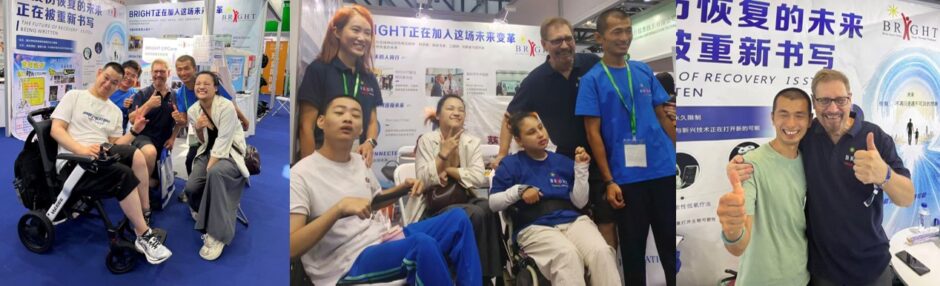
BRIGHT convened a Successful Cross-Disciplinary HIE/CP Working Session Following the 2026 CIBR/Nature Beijing Brain Conference
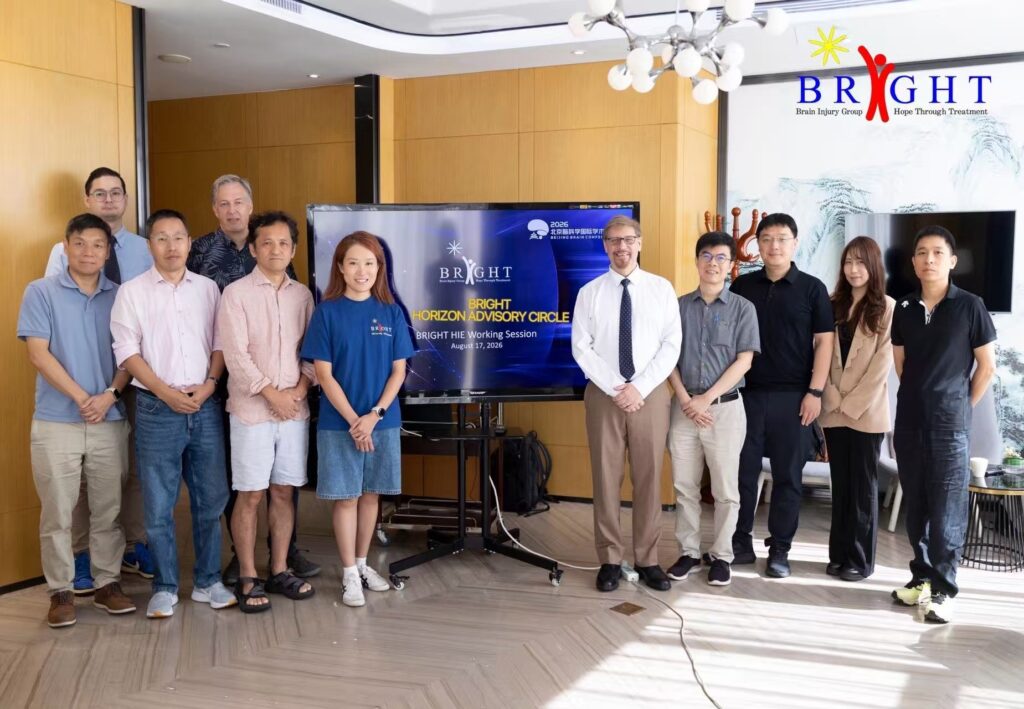
Beijing, August 17, 2026 — Against the backdrop of rapid advances in global brain science, breakthroughs are emerging across neuromodulation, artificial intelligence, and rehabilitation engineering. Yet for cerebral palsy, especially long-term functional impairment caused by hypoxic-ischemic encephalopathy (HIE), more cross-disciplinary dialogue is still needed to connect basic brain science, engineering technology, clinical rehabilitation, and the real needs of families.
BRIGHT Foundation (BRIGHT) is a patient-family-founded support and research organization dedicated to long-term family support for HIE/CP, scientific research intelligence, and cross-disciplinary exchange. As a patient-family-driven platform, BRIGHT utilized the opportunity of the 2026 Beijing Brain Conference to create a focused, open, and cross-disciplinary setting for dialogue around the complex challenge of HIE/CP.
From August 14 to 16, 2026, the 2026 Beijing Brain Conference, co-hosted by the Chinese Institute for Brain Research, Beijing (CIBR) and Nature Portfolio, was held in Beijing. This premier international forum brought together 37 elite scientific presentations— including five world-renowned national academy members —and was attended by approximately 800 in-person experts while drawing a cumulative audience of nearly two million online and onsite participants. BRIGHT participated as a peer-reviewed poster presenter, introducing its abstract titled “Beyond Top-Down Control: Operationalizing Connectome Circuits for HIE Restoration via The NeuroLoop Protocol”. The poster introduced BRIGHT’s ongoing thinking around long-term functional recovery in HIE/CP, translational neuroscience, and The NeuroLoop Protocol, a neuro-rehabilitation framework currently being explored by BRIGHT.
The BRIGHT-organized August 17 working session brought together 10 cross-disciplinary experts from basic research, engineering translation, AI, and clinical practice. On the basic research side, participants included Dr. Yihong Ye, Deputy Director for Academic Affairs and Distinguished Investigator at CIBR; Dr. Don Cleveland, Distinguished Professor at the University of California, San Diego and 2018 Breakthrough Prize in Life Sciences laureate, who was invited to share his extensive experience partnering with patient advocacy organizations to design fast-moving, proactive translational frameworks; Dr. Vincent Cheung, Associate Professor at the School of Biomedical Sciences, Faculty of Medicine, The Chinese University of Hong Kong; Dr. Alexander Gail, Professor of Sensorimotor Neuroscience and Neuroprosthetics at the University of Göttingen; and Dr. Kazuhiko Seki of the National Institute of Neuroscience, National Center of Neurology and Psychiatry, Japan. Dr. Stephen Scott, Professor in the Department of Biomedical and Molecular Sciences at Queen’s University, Canada joined the meeting through a pre‑session exchange.
From the engineering and translational technology side, Dr. Yanan Sui, Associate Professor at the School of Aerospace Engineering, Tsinghua University, and Dr. Xingwei An, Associate Professor at Tianjin University with a focus on neural engineering, joined the discussion. From the artificial intelligence side, Dr. Haiguang Liu, Chief Scientist at Beijing Zhongguancun Academy, contributed critical insights on how developments in embodied intelligence can be integrated into neurorehabilitation modeling. Dr. Changyu Lu, Deputy Director of Neurosurgery at Peking University International Hospital, was invited to share frontline clinical perspectives on long-term rehabilitation and family support for patients with brain injury.
Together, the participants created a dialogue structure spanning basic brain science, motor control mechanisms, AI and engineering systems, and real-world clinical settings.
At the beginning of the meeting, BRIGHT Founder Matt Palaszynski introduced the long-standing cause and core problem behind the initiative. BRIGHT’s work grew out of more than two decades of lived observation by families facing the realities of HIE/CP. From that perspective, HIE/CP is not only an isolated brain injury. It may involve long-term, interacting challenges across airway function, digestion, autonomic regulation, muscle tone, motor learning, and cognitive development.

Dr. Alexander Gail addresses BRIGHT founder Matt Palaszynski with Dr. Kazuhiko Seki looking on
Palaszynski noted that a challenge this complex and persistent cannot be addressed by a single discipline or a single technical pathway alone. Instead, neuroscience, rehabilitation medicine, engineering, AI, wearable sensing, and real-world family observation need to be brought into the same problem frame. Reflecting on the significance of the room, Palaszynski highlighted how this 2026 assembly mirrored BRIGHT’s 2003 inaugural Scientific Advisory Board assembly, which brought together pioneer visionaries like Dr. Michael Johnston, Dr. Neville Hogan, and Dr. Edward Taub, who ultimately went on to become the foundational leaders of modern global neurorehabilitation.
Palaszynski shared a profound realization forged from 25 years of lived experience: the frontier science envisioned by those 2003 foundational leaders is no longer a distant academic aspiration, but is now actively coalescing into a tangible, near-term timeline. He noted that the true breakthrough of 2026 is not the arrival of entirely new biological theories, but a historic technological convergence—where modern basic science, neuro-engineering, localized data streams, and computational tools have finally caught up to the original vision of functional restoration, transforming historical ideals into an actionable blueprint for families on the near horizon.

Dr. Ye Yihong, Deputy Director for Academic Affairs and a Distinguished Investigator at the Chinese Institute for Brain Research, Beijing (CIBR) represented Director Luo Minmin at the meeting. Here he addresses the group with Matt Palaszynski, Dr. Don Cleveland to the left and Dr. Liu Haiguang, Chief Scientist and Director of Research at the Beijing Zhongguancun Academy (ZGCA) looking on.
He emphasized that the NeuroLoop Protocol operates as an open-access conceptual framework—not a commercial product—designed for organizing complex scientific information, connecting cross-disciplinary data, and helping families and researchers formulate more testable hypotheses.
BRIGHT is also using AI tools to continuously track emerging studies in brain injury, neurorehabilitation, robotics, and related fields. Through cross-disciplinary screening and classification, BRIGHT aims to help families and researchers better understand which new studies may hold meaningful translational value. From a patient-family-driven perspective, BRIGHT hopes to help frontier science move beyond papers and laboratories toward real patients and families in a more responsible and efficient way.
During the roundtable discussion, participants offered observations and suggestions from their respective fields, focusing on the basic science questions, engineering boundaries, clinical realities, and long-term collaboration opportunities involved in HIE/CP translation.
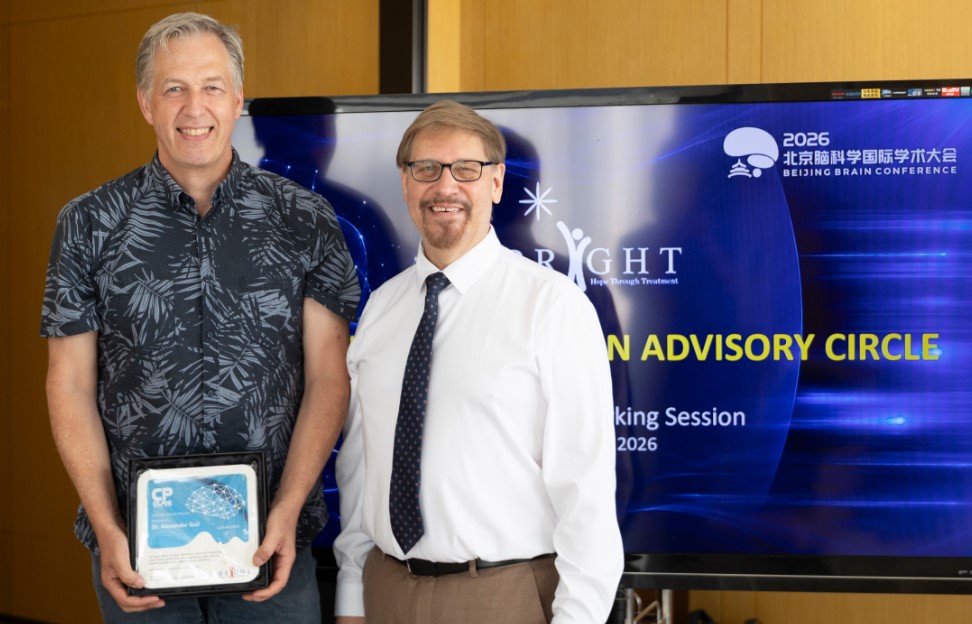
Dr. Alexander Gail is presented with a commemorative plaque by BRIGHT Founder Matt Palaszynski, recognizing his appointment to the Horizon Advisory Circle and his dedication to translational excellence in basic science..
- Interdisciplinary research environments and complex brain science challenges
Dr. Yihong Ye spoke from the perspective of CIBR’s cross-disciplinary research environment. He noted that today’s brain science challenges are highly complex, and that major problems such as brain injury and neurological disease require scientists from different backgrounds to work together in more integrated interdisciplinary settings. He emphasized that platforms such as CIBR, which bring together multiple research disciplines, are important environments for advancing dialogue around complex brain science problems.
- Engineering translation and non-invasive technology exploration
Dr. Yanan Sui and Dr. Xingwei An provided reference points for BRIGHT’s future thinking around engineering translation and non-invasive technology. Dr. Sui introduced his work on safe optimization of neural stimulation parameters, robotic control, and neuro-driven musculoskeletal modeling, emphasizing that high-dimensional stimulation and control systems must be optimized gradually within clearly defined safety boundaries. Dr. An introduced related work at Tianjin University Medical School in non-invasive neuromodulation, EEG, eye tracking, and IMU-based movement analysis, and noted that stronger bridges are still needed between non-invasive frontier technologies and clinical applications.
- Sensory feedback, motor control, and functional quantification
Dr. Kazuhiko Seki and Dr. Vincent Cheung pointed toward fundamental questions in long-term functional recovery for HIE/CP: how sensory feedback, motor control, proprioception, muscle synergies, and cortical feedback interact to shape motor learning. Dr. Seki emphasized that many daily movements may rely on subcortical and spinal closed-loop systems, and that the relationship among sensory input, proprioception, and motor feedback deserves further study. Dr. Cheung discussed muscle synergies and motor control modules, suggesting that future work may explore whether basic control modules can become observation points for intervention and functional improvement. These real-time discussions built directly upon foundational perspectives shared with Palaszynski by Dr. Stephen Scott, Professor at Queen’s University, Canada, whose long-standing work on upper-limb dynamics and feedback control offers an important academic reference for quantifying objective motor change.
- Intelligent sensing, behavioral analysis, and AI entry points
Dr. Alexander Gail and Dr. Haiguang Liu highlighted future entry points from intelligent sensing, behavioral analysis, and AI. Dr. Gail noted that low-cost sensors, markerless motion capture, camera systems, and modeling technologies are creating new possibilities for non-invasive behavioral analysis and intent prediction. He also emphasized that systems designed for real-world family environments must first define the specific problem, constraints, and boundaries. Dr. Liu suggested that developments in movement coordination, trajectory prediction, and embodied AI may create new technical entry points for functional support in HIE/CP.
- Clinical realities, patient-led partnerships, and the urgency of translational timelines
Dr. Changyu Lu, Deputy Director of Neurosurgery at Peking University International Hospital, spoke from frontline experience about the long-term pressures facing families of brain‑injured patients. “We must give families confidence, but also the right judgment—not every patient needs surgery,” he said, emphasizing that careful clinical evaluation is essential to avoid unnecessary procedures while identifying when rehabilitation or long‑term management is more appropriate. Dr. Don Cleveland of the University of California, San Diego, recognized the panel’s shared intent, stating, “I think we all recognize Matt’s commitment to this.” While noting that his own laboratory’s focus on therapies for neurodegenerative diseases differs from the specific motor-recovery and movement-focused interventions discussed by the panel, Dr. Cleveland warmly commended the cross-disciplinary expertise assembled in the room and extended his highest wishes for the foundation’s forward efforts before departing early due to travel scheduling constraints.
At the close of the meeting, BRIGHT announced the launch of the 2026 BRIGHT Horizon Advisory Circle and invited participating scholars to join this cross-disciplinary network. The mission of the 2026 BRIGHT Horizon Advisory Circle is to begin from the real needs of patient families, connect expertise across multiple fields, and sustain high-quality dialogue, translational research discussion, and public communication around the global challenge of HIE/CP.
Through this network, BRIGHT hopes to connect the real questions accumulated by patient families over many years with frontier thinking from global brain science and engineering. As a patient-driven support and research organization, BRIGHT will continue working in an open, long-term, cross-disciplinary way to connect scientists, engineers, clinicians, and real families, and to explore how advances in brain science can move more responsibly and efficiently toward the people who need them most.
About the BRIGHT Foundation
The BRIGHT Foundation is a global patient-family-driven support and research organization operating as a collaborative academic research consortium and patient-driven accelerator. Dedicated to accelerating translational neuroscience broadly for brain injury, and specifically for hypoxic-ischemic encephalopathy (HIE) and cerebral palsy (CP), BRIGHT bridges the gap between frontier scientific research, engineering innovation, and the real-world lived observations of affected families to foster responsible, evidence-based functional recovery frameworks. For more information about the BRIGHT Foundation’s initiatives and the NeuroLoop Protocol Framework, please visit www.cpcure.org
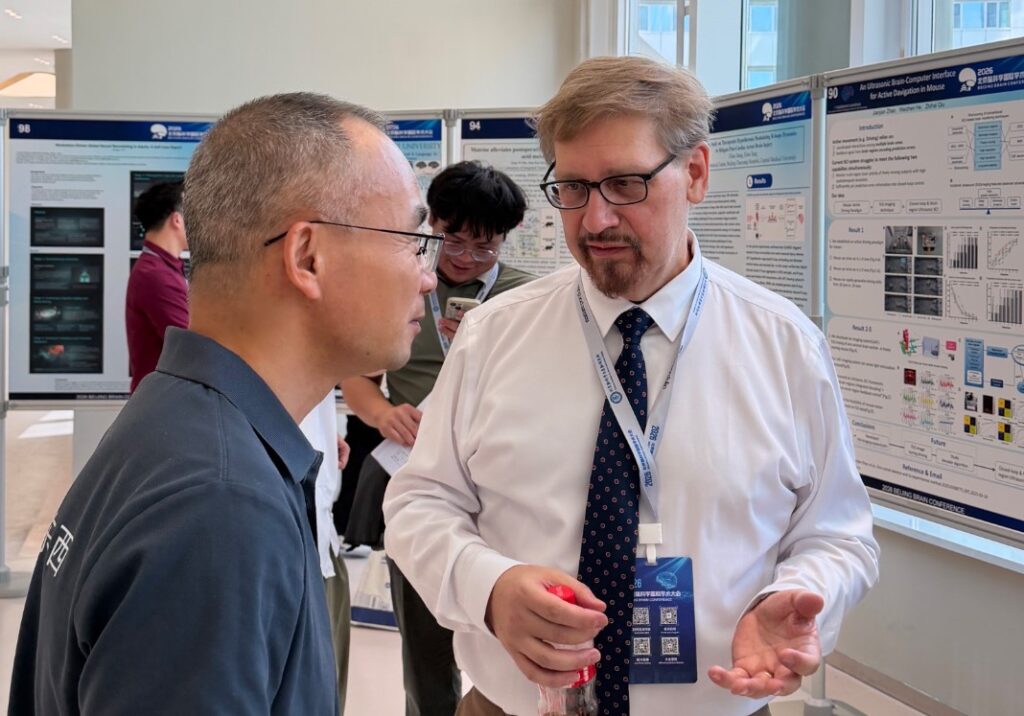
Dr. Luo Minmin, Co-Director and Distinguished Research Fellow, Chinese Institute for Brain Research (CIBR); Principal Investigator, National Institute of Biological Sciences (NIBS) and BRIGHT Founder Matt Palaszynski discuss BRIGHT’s Peer-reviewed Poster presented at the 2026 Beijing Brain Conference Poster Session
APPENDIX:TECHNICAL INTERVIEW SECTION
Editor’s Note: The following technical Q&A section reflects the exclusive strategic, commercial, and operational perspectives of the BRIGHT Foundation. These viewpoints, analyses, and critiques regarding systemic research models are independent institutional positions of BRIGHT and do not represent the official endorsements, research parameters, or organizational policies of the individual academic, engineering, and clinical scholars participating in the 2026 BRIGHT Horizon Advisory Circle.
Question 1: The current brain-computer interface investment and media narrative is heavily concentrated on ALS, spinal cord injury, and increasingly, mental health. Cerebral palsy and other chronic brain injuries remain largely outside this spotlight. From your dual perspective, how do you understand this gap? Is it primarily a scientific and technical barrier, or a function of commercial risk-return calculations?
Matt Palaszynski : The marginalization of cerebral palsy and chronic brain injury from the mainstream BCI investment narrative is a failure of commercial risk-return modeling—not a scientific dead end.
The numbers framing this crisis are staggering. According to global neurological health data celebrated at the Chinese Institute for Brain Research (CIBR), brain injuries afflict 15 million people annually, transforming them into the world’s number one killer of healthy adults and the single highest social cost of long-term care across almost all nations. Despite this immense societal burden, venture capital and media spotlights flow almost exclusively toward point-solutions for acute spinal cord injuries or linear neurodegenerative conditions like ALS. Legacy financial structures favor these applications because they present a predictable, localized “input-output” business case.
Traditional market structures look at the distributed, non-linear injury trajectory of cerebral palsy or chronic brain injury, label it as “too complex,” and retreat into funding passive maintenance and comfort care. This is a massive economic and human miscalculation. From a system engineering perspective, the pediatric and recovering brain possesses the ultimate natural asset: profound neuroplasticity. China’s strategic push to cultivate high-quality productive forces (新质生产力) creates a framework to completely disrupt these commercial roadblocks. By championing non-invasive neurostimulation protocols, we can convert what traditional venture capital considers a complex commercial risk into the world’s most scalable public health and macroeconomic triumph. We refuse to accept lifelong maintenance; it is time to pivot the entire narrative toward active, functional cures.
Question 2: Tools like large language models, automated knowledge graphs, and hypothesis-generation engines are reshaping how researchers navigate literature. Have you explored integrating these computational tools into BRIGHT’s synthesis workflow? And more broadly, do you see AI as a scalable amplifier for patient-advocate-driven research, or does the nuance of clinical interpretation still require human judgment at every step?
Matt Palaszynski: We have institutionalized this approach through the BRIGHT Horizon Filter, shifting our model from a passive research archive into an active precision synthesis engine.
Our AI-driven, human expert-curated system processes and extracts data from hundreds of weekly peer-reviewed studies, across ten distinct biomedical and engineering verticals that we call Domains. AI acts as an invaluable scale amplifier for parent-advocate-driven research, giving grassroots groups like CPCure.org the analytical bandwidth to match elite academic labs.
Yet, AI remains the machinery, not the master. Clinical interpretation—especially when aiming for a functional cure—still mandates human-level judgment at key junctures. An AI architecture can seamlessly connect thousands of variables across fragmented research papers, but it lacks the qualitative clinical context required to map real-world motor performance.
We utilize computational engines to swiftly isolate high-probability hypotheses from massive pools of literature. Human validation then steps in to shape those findings into viable protocols. This operational layout aligns cleanly with China’s broader tech-healthcare goal: accelerating computational discovery without divorcing it from deep clinical expertise.
Question 3: From an engineering standpoint, where do you see the most realistic near-term intersection between these AI/robotics capabilities and functional recovery for chronic brain injury? What is the critical engineering constraint that still needs to be solved before these systems can move from promising pilots to reliable daily tools for families?
Matt Palaszynski: The most practical near-term intersection between engineering and functional recovery lies in pairing non-invasive neurostimulation—such as transcutaneous auricular vagus nerve stimulation (taVNS)—with task-oriented, AI-guided soft robotics.
Our active strategic alliance with Peking University International Hospital (PKUIH), and growing cooperation with CIBR, Tsinghua, and the ZGC Academy are built specifically to bridge this gap. The just-concluded 2026 Beijing Brain Conference and BRIGHT’s August 17th HIE working session threw a powerful spotlight on closed-loop stimulation, demonstrating remarkable initial milestones in animal models and initial human pilots. China has definitively positioned itself as a primary driver in this technological domain.
Crucially, the primary constraint standing in our way is not a technical limitation of hardware or software. We do not need hyper-fast, millisecond-level closed-loop accuracy to make a profound clinical impact on a child’s mobility. Much of the baseline engineering capabilities already exist and have been validated.
The true critical constraint is system optimization and deployment leadership. We need focused orchestration to take these validated closed-loop protocols out of isolated laboratory silos and transform them into standardized, functional tools that can be reliably used by families at home. The technology is entirely feasible right now; what it urgently demands is a dedicated champion to build the translational ecosystem. China’s unmatched hardware production ecosystem and nimble clinical testing frameworks make it the ideal launchpad to scale this capability.
Question 4: Do you believe computational and data-science approaches—such as real-world evidence platforms, federated data networks, or predictive outcome modeling—could structurally change how discoveries translate from journal articles to patient homes? If BRIGHT could catalyze one data or AI initiative to accelerate this translation, what would it be?
Matt Palaszynski: Moving medical discoveries out of academic journals and directly into patient homes requires a fundamental structural pivot away from static data pools toward dynamic, “N-of-1” predictive outcome modeling.
Historically, the BRIGHT Foundation and the wider research community built traditional central repositories. However, for many conditions, centralized data aggregation is not the final answer. Because cerebral palsy and chronic brain injuries express uniquely in every individual, traditional group averages fall short. The key to clinical breakthrough is the N-of-1 architecture, treating each patient as their own unique, evolving clinical trial.
Because an N-of-1 approach relies on massive, highly granular data streams tracked over time, advanced AI modeling becomes absolutely mandatory. If BRIGHT could catalyze a singular data initiative to unlock this, it would be a Secure Federated Data Network for Neuroregeneration.
Instead of moving sensitive clinical information into a single database, a federated framework keeps data safely within host institutions—like our clinical partners across China—while letting AI models train across the collective global network. This allows us to track patient data streams continuously, modeling how combinations of biology, modulation, and targeted stimulation impact functional recovery in real time. It provides an actionable roadmap that respects data security while delivering immediate, data-backed guidance to individual families.
Download the PDFs:
First BRIGHT Horizon Leadership Board (HLB) Meeting press release
(Chinese Version) First BRIGHT Horizon Leadership Board (HLB) Meeting