
Redefining Brain Injury and Cerebral Palsy Rehabilitation
The False Horizon: A Quarter-Century of Blind Flying
For a family or adult navigating Brain Injury, Stroke, Cerebral Palsy (CP) or Hypoxic-Ischemic Encephalopathy (HIE), the clinical landscape can feel like a relentless loop of hope and heartbreak. Famalies spend years cycling through therapies—investing thousands of hours and entire lifespans into mainstream approaches like intensive physical therapy, or alternatives like hyperbaric oxygen therapy (HBOT), specialized nutrition, niche approaches like Feldenkrais, target supplements, and cutting-edge neuromodulation. Yet, when they sit in a clinic, the verdict of progress relies on legacy metrics: subjective checklists, manual grading scales (like the standard Gross Motor Function Measure), or a therapist with a stopwatch.
This is clinical blind flying. A legacy test logs a success if a survivor finishes a task faster today than last month, but it fails to see how they completed it. It misses the hidden cost.
Standard assessments have historically trapped patients in a harmful paradox: either blindly rewarding destructive compensatory movements that cause irreversible orthopedic breakdown, or punishing safe, adaptive movements that could unlock life-changing independence. Families are left asking the same agonizing questions: Is this therapy actually working? Is my loved one truly doing better or worse than expected for their specific level of injury severity? Or are we just burning precious time and resources on another plateau?
The EarnedGain Framework (EGF) and VectorDail Dashboard (VDD) change the game entirely. It is not a subtle clinical update; it is an foundational paradigm shift. By acting as an intervention-agnostic, real-time mathematical mirror, EGF removes the guesswork. Whether a loved one is responding to a new neuromodulation protocol, a dietary change, or standard physical therapy, the framework strips away the noise to reveal true neurological impact in an N-of-1 framework.
The Human Need: Validating the Invisible
The core of the EarnedGain Framework is born out of a profound human need: to give families and clinicians a definitive baseline tailored exclusively to one single individual. Because every brain injury creates a highly distinct neurological footprint, applying population averages to a child with CP or an adult with a stroke, is a fundamental mismatch.
Consider a mid-severity patient who suddenly locks up during an evaluation or social interaction. In a standard setting, this is frequently misunderstood as behavioral anxiety, stubbornness, or a psychological hurdle. The framework exposes a different physical reality for HIE victims: a regulatory failure between the dlPFC and the motor cortex where, under stress, the neurological loop does not overload, but rather becomes inflexibly locked—depriving the brain of its natural ability to throttle the loop and transition smoothly between thoughts, emotions, or movements.
Without objective tracking, these micro-struggles are invisible, and genuine micro-gains go unrewarded. EarnedGain establishes a mathematical boundary to validate these quiet victories, separating true pathway saturation from behavioral factors, and ensuring no child is written off due to flawed assessment tools.
If even CP people can’t agree…
To further emphasize why a new measurement approach is needed, please look directly at a recent, raw exchange within the adult CP community. It exposes the profound fragmentation between how different severity levels experience the world—and how easily neurological failure is mischaracterized as a psychological flaw.
In a recent chat group, a mid-severity adult shared his daily workplace trauma:
“When I try to communicate, my emotions spike, my brain’s control loop misfires, my body locks up, and I lose the physical ability to show people who I really am on the inside. If we could neurologically control this circuit, it would solve our greatest barrier. This loop failure causes real trauma in the workplace.”
A mild-severity adult quickly replied, looking at the issue through a purely psychological lens:
“This isn’t a disease problem; anyone gets anxious when they can’t express themselves. Through exercise and rehab, your physical status is already great. Don’t label yourself. This is just a normal emotional reaction mixed with perfectionism—you aren’t allowing yourself to be different.”
The mid-severity adult immediately retreated:
“My intentions are good, but when I speak unclearly, people lose patience and cut me off. It causes real harm in my career. But maybe you’re right. Maybe my expression is just too emotional, and I am lacking in that area.”
This exchange exposes a devastating social and clinical dynamic. Because the mid-severity adult’s physical lock-up occurred under emotional stress, it looked indistinguishable from a standard anxiety response to an outside observer. The consequence was immediate: the user shut down, internalized the criticism, and resolved to over-censor his future comments.
This is a form of unintentional but destructive clinical and social gaslighting that happens every day: “You’re just being too sensitive. It’s all in your head. Just focus and calm down.”
But it is not in his head. It is a physical, bottom-up breakdown of the communication loop between the dorsolateral Prefrontal Cortex (dlPFC)—the region responsible for emotional regulation and cognitive load—and the motor cortex. When emotional or communicative stress spikes, the fragile, injured neural pathways of a moderate-to-severe patient experience extreme cognitive and physical strain. The circuit becomes locked in a loop. The person inside remains entirely capable, but the internal communication becomes locked in a repeating loop.
Without objective data, well-meaning peers and clinicians will continue to prescribe inaccurate advice for structural neurological failures. The EarnedGain Framework was built to draw an undeniable, mathematical boundary line between psychological anxiety and structural pathway saturation. It is designed to level the playing field between mild vs severe patients and ensure that the small gains of a severe patient are amplified to match the larger expected gains of a mild patient.
The Safe Movement Envelope
To break this loop, EGF introduces an approach to movement adaptation. It will not score compensatory movements as an automatic failure. Instead, by integrating with open-source biomechanical and body-modeling databases like OpenSim, EGF maps out a personalized Safe Movement Envelope.
The system will welcome functional compensations that give a patient a new way to interact with the world. It steps in to alert clinicians only when a movement trajectory shifts outside that safe boundary, threatening long-term mechanical wear on joints, cartilage, or ligaments. It protects the body while liberating the mind.
Industrial Systems Architecture & Technical Pipeline
The EarnedGain Framework is not an academic hypothesis; it is being engineered using a rigorous industrial optimization pipeline that bridges specialized hardware manufacturing with advanced complex network data models.
- Data Infrastructure & Edge Core: Engineered by Matt Palaszynski & Awais Ahmad Siddiqi (Tsinghua University School of Software / BNRist). Awais has expertise in translating state-of-the-art contactless mmWave radar tracking, biometric-assisted multi-person tracking, and micro-gesture recognition into a local, edge-computed reality.
- The Analytical Engine: Leverages advanced Minimum Spanning Tree (MST) and Complex Network Analysis to mathematically map functional neural brain connectivity—specifically isolating real-time throughput variations in the dlPFC-motor loop under acute stress.
- Operational Validation: Managed via a 501(c)(3) systems engineering protocol stripped of all commercial medical-device conflict of interest, optimizing human motor adaptation the same way a global industrial enterprise handles zero-tolerance manufacturing.
Technical Infrastructure: The Edge-Compute Architecture
To pull this off without relying on erratic, noise-heavy consumer tech, EGF moves processing away from distant cloud servers and places it directly where the patient moves. Wearable sensors alone are notoriously vulnerable to motion artifacts and sensor drift, often mistaking a spasming muscle or a slipped strap for genuine intentional movement.
EarnedGain solves this via local, real-time on-device edge computing paired with a specialized Markerless Motion Capture and IMU Sensor Fusion engine. By cross-referencing live video tracking with the rigid physical realities of inertial data, the system filters out environmental noise at the millisecond level, delivering high signal fidelity.
N-of-1 Baselines & The Rolling 30-Day Trajectory
Because a population curve cannot accurately predict the recovery path of a uniquely injured brain, the framework operates as a purely longitudinal biometric detective for a single human being.
The Live Baseline: Rather than only using speculative, predictive brain imaging scans like DTI or fMRI to guess at limits, EarnedGain build on top of the imaging data from the ground up using live, objective behavioral data. It will directly incorporate the hyper-sensitive jittery motion decoding models pioneered in Week 26 to assess raw coordination limits. From this live baseline, the system will project highly practical rolling 30-day functional trajectories to forecast upcoming capabilities.
Foundational Peer-Reviewed Validation
The computational core of the EarnedGain Framework is structurally validated by groundbreaking research published in PLOS Digital Health (Wen et al., 2026; DOI: 10.1371/journal.pdig.0001598).
Utilizing a massive “in the wild” home rehabilitation dataset, this landmark study mathematically proved that state-space models can successfully isolate true motor learning trajectories from temporary performance spikes and external noise. A critical finding of the study confirms that standard dose-response rehabilitation fails because massive individual variances completely overshadow group averages—solidifying the absolute clinical necessity for an N-of-1 framework.
Building Beyond the State-Space Foundation
While the PLOS Digital Health study successfully models performance memory trajectories (τ) using text/tap dose-response inputs, the EarnedGain Framework takes this architecture to the next logical frontier:
- From Static Input to Live Stream: Where foundational state-space models rely on manual or macro-level exercise repetitions, EGF infuses real-time Markerless Motion Capture and IMU Sensor Fusion to feed the state-space equation automatically at the millisecond level.
- The Autonomic Variable: EGF explicitly introduces a missing critical parameter to the mathematical model: autonomic stress metrics. By cross-referencing movement degradation directly against stress loads, our engine isolates whether a performance drop-off is due to physical memory decay or a regulatory lock-up in the dlPFC-motor loop.
By building directly on top of this peer-reviewed math, the VectorDial Dashboard graduates from a predictive concept into a precision, evidence-backed mathematical mirror.
The VectorDial Dashboard: A Four-Tiered Interface
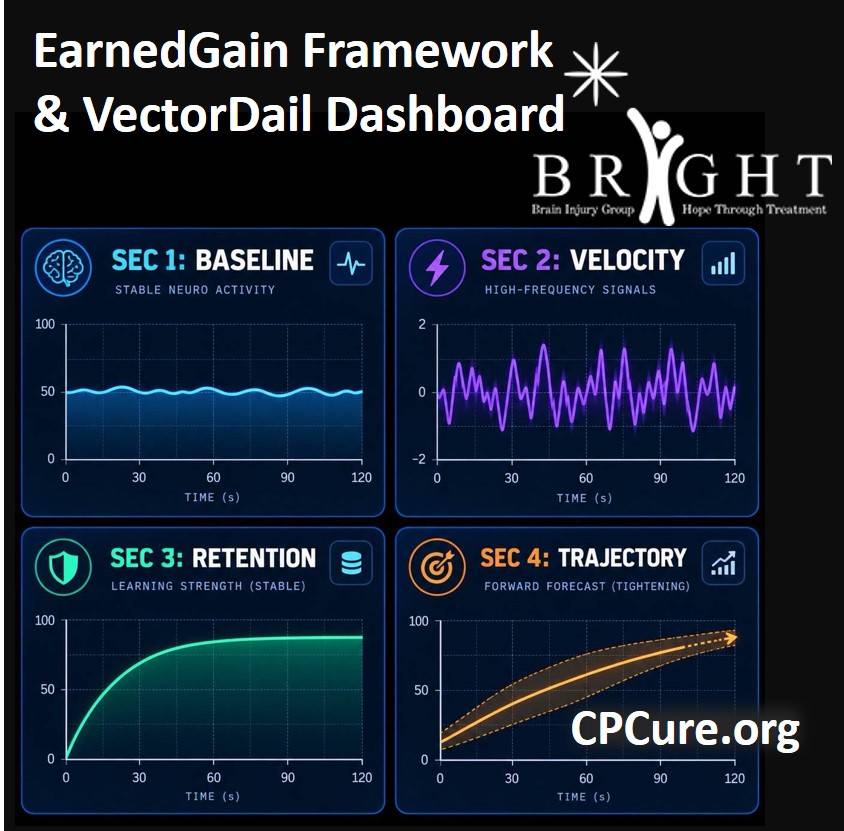
To make this advanced data stack actionable for a family at home or a therapist in a clinic, the dashboard translates complex mathematical streams into a clear, four-layered visual timeline:
Section 1: The Baseline (The Autonomic Stress Test)
To eliminate bias, either in the clinic or well meaning friends, this layer utilizes a rapid evaluation protocol that introduces escalating cognitive and communicative loads. By mapping movement degradation directly against autonomic stress metrics, it pinpoints the exact moment emotional or environmental stress overloads neurological bandwidth, exposing the dlPFC-Motor Loop in real time.
Section 2: Short-Term Impact (The Velocity Signals)
Caregivers and patients need to see if an intervention is making a difference right now. This section tracks high-sensitivity velocity signals to capture instantaneous neurological shifts:
- Micro-Smoothing: Measures immediate reductions in micro-tremors and mid-path corrections.
- Phase-Locking Coherence: Tracks how cleanly a patient’s motor intent aligns with their actual physical execution.
- Initiation Latency: Measures the critical time delay between a cue and the physical start of a movement.
Section 3: True Motor Learning (The Retention Coefficient – τ)
Temporary performance spikes are common in rehabilitation—often driven by a good night’s sleep, a temporary therapy “warm-up” effect, or medication windows. Section 3 strips all of this away. By mathematical normalization across environment, sleep data, and medication schedules, it isolates the permanent Neuroplastic Retention Coefficient (τ). This is the definitive metric of structural neuroplastic consolidation.
Section 4: The Predictive Trajectory
Instead of leaving families to wonder about the long-term outlook, this layer deploys a dynamic rolling forecasting engine. It takes the true structural retention data (τ) and projects a localized trajectory 30 days into the future. As data volume grows, the variance boundaries tighten, transforming vague clinical prognoses into clear, data-backed operational targets.
Deployment Architecture & Status (as of October 2026)
- Biomechanical Modeling Core: Powered by the open-source Stanford OpenSim Engine API for personalized structural boundaries.
- Algorithmic Modeling State: Complex Network and motion tracking sensor fusion tracking arrays are actively being calibrated for multi-modal patient stratification.
- Audit Status: Operating under strict, non-commercial open data oversight by the BRIGHT Foundation Advisory Boards.
- Operational Status: The mathematical framework is established and is currently being validated via a pilot physical multi-modal data acquisition system that is actively undergoing live tests.
Creator Credentials & Verification
- Author: Matt Palaszynski, Founder of the BRIGHT Foundation (501(c)(3) non-profit founded in 2002).
- Lived Experience: Over 25 years navigating clinical care models for a daughter with CP.
- Background: GE Alumnus applying industrial systems engineering to peer-reviewed NCBI PubMed research.
- Conflict of Interest Statement: The BRIGHT Foundation maintains zero commercial or business interests in any medical devices or entities reviewed.