
Beyond the Stopwatch & GMFM: Redefining Brain Injury / Cerebral Palsy Rehabilitation with the EarnedGain Framework
A review of 200 new global studies published in the week of August 31st, 2026 yields one (1) Additive finding. “To learn or not to learn? Model-based estimation of motor learning in a large, ‘in the wild’, home rehabilitation database.” published in PLOS Digital Health with DOI 10.1371/journal.pdig.0001598
This article provides a mathematical foundation for BRIGHT’s EarnedGain Framework.
Executive Summary: Horizon Filter Evaluation – Week 36, Aug 31st, 2026
The legacy models of Cerebral Palsy (CP) and Hypoxic-Ischemic Encephalopathy (HIE) rehabilitation are broken. For decades, clinical progress has been measured by subjective checklists, manual mobility scales like the GMFM, or simple completion times. If a patient completes a physical task faster today than they did last month, legacy medicine logs it as a success.
But this approach treats a highly complex neurological process like a simple stopwatch. It misses the underlying truth of the condition, and worse, it completely ignores the lived reality of those navigating the spectrum of severity. It rewards pathological compensatory movements—such as hyper-extending a shoulder to force a spastic wrist to move—validating a destructive “cheat code” while the underlying neural pathway continues to degrade.
To fix neuro-rehabilitation, we must move beyond the stopwatch & manual grading and reject the institutional urge to group unique individuals into rigid, standardized clinical buckets. cpcure.com is doing exactly that by introducing the EarnedGain Framework, powered by BRIGHT’s NeuroLoop Protocol which will feature edge-compute, sensor-fusion, and hyper-individualized N-of-1 mathematical architecture.
If even CP people can’t agree…
To understand why a new measurement paradigm is required, please look directly at a recent, raw exchange within the adult CP community. It exposes the profound fragmentation between how different severity levels experience the world—and how easily neurological failure is mischaracterized as a psychological flaw.
In a recent chat group, a mid-severity adult shared his daily workplace trauma:
“When I try to communicate, my emotions spike, my brain’s control loop misfires, my body locks up, and I lose the physical ability to show people who I really am on the inside. If we could neurologically control this circuit, it would solve our greatest barrier. This loop failure causes real trauma in the workplace.”
A mild-severity adult quickly replied, looking at the issue through a purely psychological lens:
“This isn’t a disease problem; anyone gets anxious when they can’t express themselves. Through exercise and rehab, your physical status is already great. Don’t label yourself. This is just a normal emotional reaction mixed with perfectionism—you aren’t allowing yourself to be different.”
The mid-severity adult immediately retreated:
“My intentions are good, but when I speak unclearly, people lose patience and cut me off. It causes real harm in my career. But maybe you’re right. Maybe my expression is just too emotional, and I am lacking in that area.”
This exchange exposes a devastating social and clinical dynamic. Because the mid-severity adult’s physical lock-up occurred under emotional stress, it looked indistinguishable from a standard anxiety response to an outside observer. The consequence was immediate: the user shut down, internalized the criticism, and resolved to over-censor his future comments.
This is a form of unintentional but destructive clinical and social gaslighting that happens every day: “You’re just being too sensitive. It’s all in your head. Just focus and calm down.”
But it is not in his head. It is a physical, bottom-up breakdown of the communication loop between the dorsolateral Prefrontal Cortex (dlPFC)—the region responsible for emotional regulation and cognitive load—and the motor cortex. When emotional or communicative stress spikes, the fragile, injured neural pathways of a moderate-to-severe patient experience extreme cognitive and physical strain. The circuit becomes locked in a loop. The person inside remains entirely capable, but the internal communication becomes locked in a repeating loop.
Without objective data, well-meaning peers and clinicians will continue to prescribe inaccurate advice for structural neurological failures. The EarnedGain Framework was built to draw an undeniable, mathematical boundary line between psychological anxiety and structural pathway saturation. It is designed to level the playing field between mild vs severe patients and ensure that the small gains of a severe patient are amplified to match the larger expected gains of a mild patient.
An August 2026 study provides a math foundation for BRIGHT
A powerful foundational validation for the EarnedGain Framework was published just this week. A study published in PLOS Digital Health (DOI: 10.1371/journal.pdig.0001598) utilized a large home rehabilitation database to build a state-space mathematical model. Their math successfully separated transient performance changes (temporary warm-up effects or daily fluctuations) from long-term motor memory consolidation (true neuroplastic learning).
The authors achieved something monumental, but they focused their entire analysis on a single, one-dimensional metric: faster time to task completion.
The EarnedGain Framework takes the core principles of state-space motor tracking and expands them from a 1-D speed vector into a multi-dimensional array. Instead of tracking speed, EarnedGain tracks Kinetic Efficiency, Kinematic Fidelity (the purity of the movement path), and Neurological Stability.
Overcoming the Data Noise Problem Via Edge Compute
Historically, capturing this level of micro-neurological data outside of a multi-million-dollar university biomechanics lab was impossible. Wearable sensors alone are notoriously noisy, prone to slipping, and plagued by artifact errors.
EarnedGain solves this via a closed-loop multi-modal approach. By leveraging high-performance, local on-device edge computing, the framework will run a real-time Markerless Motion Capture and Inertial Measurement Unit (IMU) Fusion engine.
Instead of relying on a single noisy sensor, the system cross-references visual spatial tracking with high-frequency inertial physics locally, thus stripping out artifact noise. By processing data at the edge, the system will capture an order of magnitude more high-value, high-fidelity data than traditional clinical models, providing an uncompromised view of human movement.
BRIGHT’s Core Philosophy: Brain Injury is fundamentally an N-of-1 condition
Every single brain injury occurs at a completely unique developmental moment, leaving a highly distinct spatial footprint of tissue damage. Because of this neuro-mechanical truth, Cerebral Palsy is fundamentally an N-of-1 condition.
Traditional medicine insists on comparing patients against broad, rigid, interpersonal populations to satisfy insurance metrics. EarnedGain rejects this methodology. The framework is built on an entirely intrapersonal, self-referential model.
The system does not look sideways at global averages, nor does it subject families to the anxiety of community benchmarks. Instead, the local smart AI functions exclusively as a longitudinal biometric detective for one single human being. Its sole point of comparison is the patient’s own historical data matrix, measuring progress entirely against their own unique baseline, structural limits, and personalized optimal state-space.
The VectorDial Dashboard: A Four-Tiered Architecture
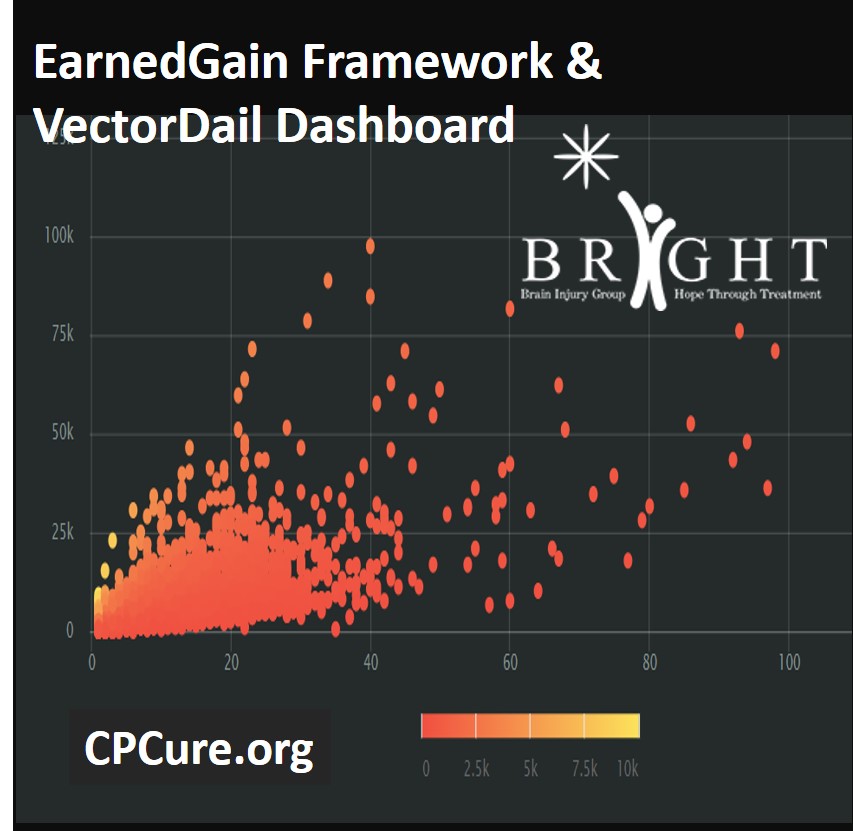
To make this advanced data actionable for families and clinicians, cpcure.com translates our edge-processed, self-referential sensor streams into a clear visual timeline: The VectorDial Dashboard. This interface categorizes data into four distinct layers.
Section 1: The Baseline
To eliminate biases, Section 1 establishes an objective baseline using an intentional, rapid evaluation protocol. The patient performs a series of basic motor tasks using the integrated markerless and physical targeting array. The evaluation session naturally escalates cognitive and communicative loads across three distinct phases, shifting from a resting baseline to time-pressured mental tasks, and finally to simulated social evaluation.
The evaluation protocol dashboard plots physical movement degradation against the spike in autonomic stress and thus can differentiate between a mild patient experiencing high stress but their movement path remains largely stable vs a moderate-to-severe patient experiencing stress and their movement path exponentially collapses, due to a dlPFC-Motor Loop Breakdown. The evaluation provides physical proof that the patient’s neural pathways have reached structural saturation. They are not failing to try; their brain has run out of bandwidth.
Section 2: Short-Term Impact (The Signal of Velocity)
Neuro-rehabilitation is an exhausting journey. Caregivers and patients need fast wins to stay motivated, and clinicians need rapid feedback loops to optimize targeted neuromodulation therapies like tACS or taVNS.
Section 2 shifts the lens to high-sensitivity micro-signals, actively hunting for transient micro-improvements across three specific areas:
- Micro-Smoothing: Measuring reductions in micro-tremors or mid-path corrections during a single movement.
- Phase-Locking Coherence: Tracking the exact alignment between the brain’s intent and physical target interaction, made possible by low latency edge processing.
- Initiation Latency: Measuring the exact delay between the cue to move and the physical start of the movement.
If a specific therapy session yields a localized improvement, Section 2 flags it instantly, providing immediate behavioral validation to the family and parameters for the clinician.
Section 3: True Motor Learning – Neuroplastic Retention (τ)
While Section 2 provides the short-term motivation, Section 3 is the unyielding anchor of the framework. It calculates the permanent Neuroplastic Retention Coefficient (τ).
To find the true, underlying baseline, Section 3 strips away transient performance spikes of neuromodulation.
This section isolates what has actually changed permanently in the physical structure of the brain manifesting as motor learning. Implemented through the smart AI layer, the system checks personal environmental factors—such as sleep metrics or medication timings—to normalize data anomalies. If Section 2 shows daily wins but Section 3 remains flat, it signals a need to adjust the therapeutic protocol, rather than a failure of the patient.
Section 4: The Predictive Trajectory
Instead of relying on speculative, fixed clinical prognoses, Section 4 utilizes a rolling forecasting engine that projects a patient’s future functional capabilities based on their real-world rate of structural retention (τ).
This forecasting engine delivers a dual-benefit that scales dynamically with data volume:
- Tightening Vertical Precision: As more rolling longitudinal data is ingested, variance decreases, and the confidence bounds automatically tighten around a precise, highly accurate trajectory unique to that patient.
- Expanding Horizontal Reach: As the system witnesses how the structural baseline holds up across varying environments and stress states over time, the forecasting engine safely extends its predictive horizon months into the future with high statistical confidence.
The Clinical Support Depth
To maintain an empowering, highly scannable visual experience for the family, the complex backend computations are pushed into a secondary layer: The Clinical Support Depth.
This background registry runs continuous causal inference algorithms to isolate exactly what variable is driving the permanent retention coefficient (τ), whether it be specific neuromodulation protocols or pure physical repetition. It also monitors long-term autonomic drift to ensure the patient’s underlying baseline resilience to everyday stressors is structurally expanding over time.
Moving Forward
The EarnedGain Framework converts the invisible, agonizingly slow process of neural repair into a clear, objective map. By grounding rehabilitation in high-fidelity edge computing, movement physics, and N-of-1 tracking rather than subjective population averages, EarnedGain does not just optimize therapy—it protecst the dignity of the patient, strips away the isolation of the severity spectrum, and replace guesswork with an undeniable trajectory of permanent recovery.
Creator Credentials
Author: Matt Palaszynski
- Founder, BRIGHT Foundation: Leading a global initiative to “close the loop” on Cerebral Palsy recovery through data-driven research.
- 25+ Years Lived Experience: Navigating life with a daughter with CP provides a primary, first-person understanding of the physiological and clinical gaps in current care models.
- GE Alumnus & Business Leader: Leveraging decades of experience in operational excellence, complex systems, and strategic leadership to apply rigorous meta-study frameworks to neurological research.
- Methodology: Combines personal advocacy with professional systems-thinking to synthesize NCBI PubMed data into the actionable NeuroLoop Protocol.
Conflict of Interest Statement
The BRIGHT Foundation and its founder, Matt Palaszynski, maintain no commercial or business interests in the medical technologies, pharmaceutical products, or clinical services discussed on this page.
- Non-Profit Mission: Our objective is purely research-driven, aimed at identifying the most effective paths to a functional cure.
- Independence: No funding is received from manufacturers of the devices or therapies reviewed in our weekly meta-studies.
- Transparency: All citations are linked directly to PubMed (PMIDs) to ensure users can verify the raw data independently.